Monthly Archives

February 2020

By CNote, Migration V2

CNote Named to ImpactAssets 50 List

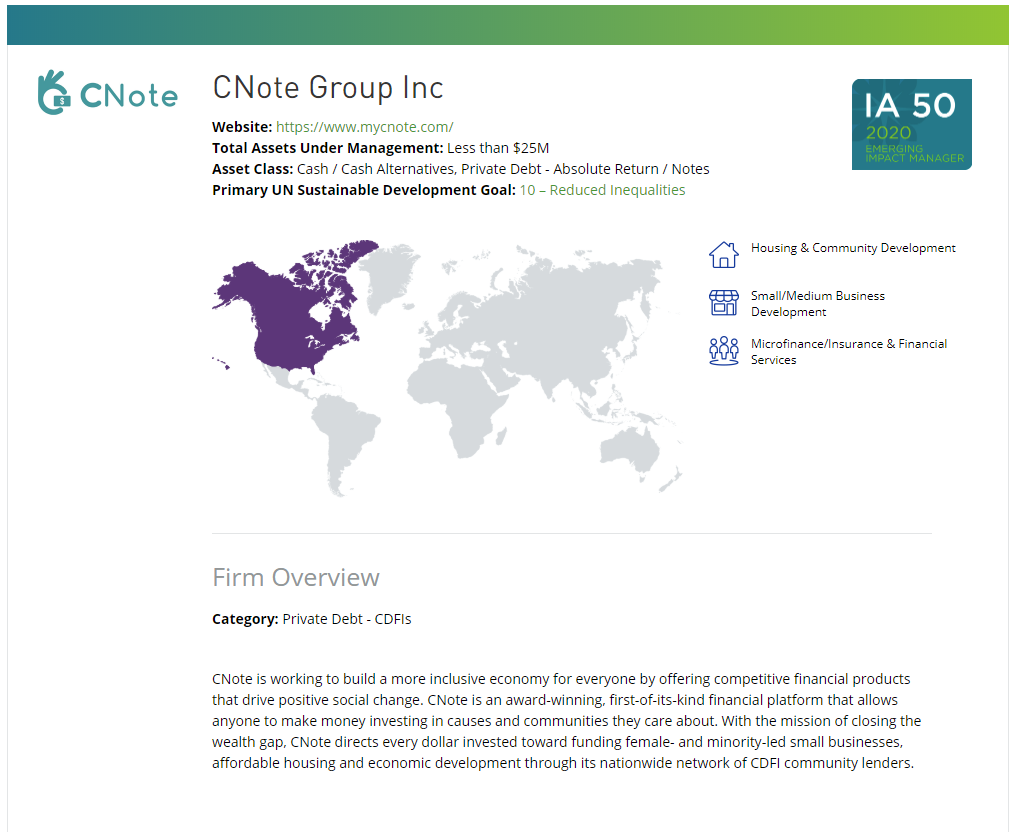
We’re proud to announce that CNote was listed as an Emerging Impact Manager on the 2020 Impact Assets 50 list of fund managers.

About The List

The ImpactAssets 50 2020 (IA 50), a publicly available, online database for impact investors, family offices, financial advisors and institutional investors that features a diversified listing of private capital fund managers that deliver social and environmental impact as well as financial returns.

To continue to shine a light on impact fund innovation, the IA 50 added a new Emerging Impact Manager category, which spotlights newer fund managers that demonstrate potential to create meaningful impact. The inaugural list includes 16 emerging fund managers across a variety of themes and geographies.IA 50 - CNote named emerging impact manager

“With record applicants and assets under management, the IA 50 continues to reflect the rapid growth and interest in impact investing,” said Jed Emerson, ImpactAssets Senior Fellow, and IA 50 Review Committee Chair. “This year’s showcase includes eleven impact funds with more than $1 billion in assets under management. And to ensure we’re capturing the best future ideas, we’ve added emerging impact managers, who have the hunger, creativity and a willingness to explore alternatives that more seasoned fund managers may not.”

The IA 50 is the first publicly available database that provides a gateway into the world of impact investing for investors and their financial advisors, offering an easy way to identify experienced impact investment firms and explore the landscape of potential investment options.  The IA 50 is intended to illustrate the breadth of impact investment fund managers operating today, though it is not a comprehensive list.  Firms have been selected to demonstrate a wide range of impact investing activities across geographies, sectors and asset classes.

Additional coverage

By CNote, Impact Metrics, Migration V2

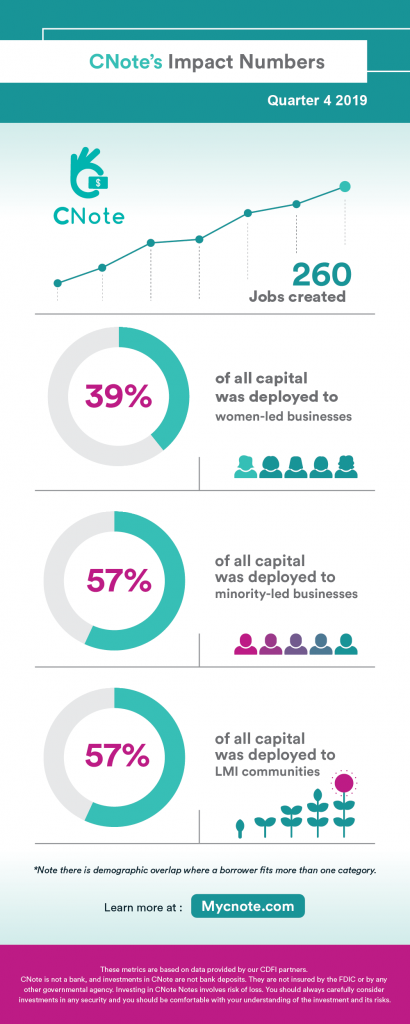
CNote’s Q4 2019 Impact Metrics

We know one of the main reasons you invest with CNote, is because of the impact your investment has.

We’re proud to share our Q4 2019 impact data.

In Q4 2019, our members helped create/maintain 260 jobs!

Over half of all invested capital was deployed with minority-led businesses.

If you’d like to see our annual impact data, along with an explanation of how we map CNote’s impact investments to the UN’s Sustainable Development Goals, read our 2018 Impact Report.

Our 2019 Annual Impact Report will be available soon.

By CNote, Impact Investing, Migration V2

CNote Launches Promise Account

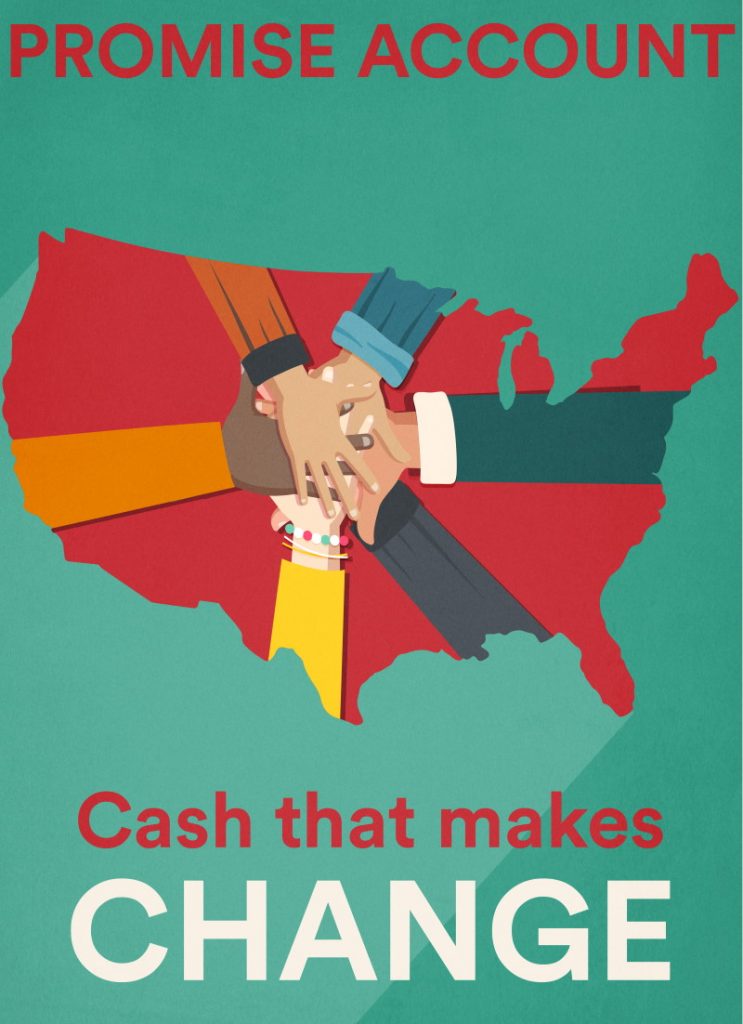
Today, CNote has officially launched The Promise Account, a cash solution that optimizes for impact and return, while being fully insured. You can learn more on the product page and read pre-launch coverage from Impact Alpha.

CNote’s Promise Account Taps Power of Cash for Competitive Returns + Social Impact

New insured cash solution shifts capital to financially underserved communities

OAKLAND, Calif.Feb. 19, 2020 — Driven by the conviction that cash holdings are an underused tool for social good, CNote has launched the Promise Account, a cash solution for foundations and other institutional investors that’s optimized for returns, impact and insurance.

The Promise Account targets a big portion of the nearly $20 trillion in cash and equivalents sitting in the market. CNote places account holders’ dollars in competitive deposit products, such as money market funds and CDs, available from vetted FDIC- and NCUA-insured community development financial institutions (CDFIs) and low-income designated (LID) credit unions. CNote optimizes this basket of products to achieve the highest returns with liquidity of 90 days or less.

A one-stop shop for cash with impact

“We see cash as the final frontier of impact because traditional cash solutions sacrifice impact, returns or liquidity,” said Catherine Berman, CEO and co-founder of CNote, a fintech platform whose mission is to close the wealth gap in the U.S. “The Promise Account fills a gap for institutional investors that want to support financially underserved communities while generating competitive returns.”

The Promise Account is a one-stop shop for cash with impact. The fee-free accounts are fully insured up to $3 million per investor through the FDIC and NCUA. Investors can sign up and manage their accounts online, with a minimum deposit of $250,000. Their money grows the deposit base at U.S. community institutions, allowing them to increase lending activity and deploy additional financial resources: CDFIs fund female- and minority-led small businesses, affordable housing and economic development, and LID credit unions serve communities where most people have household incomes well below the national median.

To replicate the Promise Account, investors would have to research mission-aligned investments across multiple financial institutions and manage multiple accounts to receive more than $250,000 in insurance coverage, maximize returns and maintain relative liquidity—a burden few would take on.

Reduced risk with enhanced reporting

“The Promise Account eliminates the barriers for accredited investors that want to invest for positive impact and need to park their cash where it’s safe and easy to access—we think it holds particular appeal for foundations,” said Berman.

“CNote provides more than deposits when we work with CDFIs and credit unions,” she added. “We act as a partner, providing technology that enables them to accept deposits more readily and efficiently. That means we get greater visibility into the impact they are creating, so we can go beyond vague assurances of community benefits and give Promise Account holders clear impact measurements.”

About CNote

CNote is an award-winning, first-of-its-kind financial platform that allows anyone to make money investing in causes and communities they care about. With the mission of closing the wealth gap, CNote directs every dollar invested toward funding female- and minority-led small businesses, affordable housing and economic development through its nationwide network of community lenders.

Read The Full Release:

By CNote, Migration V2

CNote CEO Catherine Berman Selected for InvestmentNews’ 2020 Icons and Innovators List

The entire CNote team is proud to announce that Cat Berman, our brave and inspiring leader, was selected as one of ten innovators driving change in the financial services industry!

Read the full release below.


​​​​InvestmentNews has recognized Catherine Berman as a 2020 Icons and Innovators honoree. Catherine was chosen from several hundred nominations to make the list of 10 Innovators and one Icon, Jud Bergman, former Chairman and Chief Executive Officer of Envestnet.

“It is energizing to be recognized for our work unlocking the opportunity for foundations, institutions and individual investors to earn returns while investing in underserved communities across America,” Catherine said. She added, “I am honored to be among this select list of innovators who are driving positive change in the financial services industry.”

Each of the advisers and executives who made the fourth annual InvestmentNews Icons and Innovators list was chosen from a rigorous selection process designed to identify individuals who contributed profoundly and consistently to the advancement of the financial advice profession and for conceiving new ideas and tools that have propelled the industry forward.

“The 11 individuals recognized as this year’s Icons & Innovators have led significant changes that are transforming the financial advice industry,” said George Moriarty, Chief Content Officer of InvestmentNews. “We hope their stories will inspire others to bring forward the next big ideas.”

Catherine will officially receive the award at the InvestmentNews 2020 Innovation Summit and Awards Dinner on April 30 in New York City. The half-day Summit will include panel discussions, TED-style talks, and one-on-one interviews followed by an awards dinner gathering the industry’s biggest names and brightest minds.

InvestmentNews also recognized 18 firms as finalists in its Innovation Awards in six categories: educational materials, investing solutions, practice management, retirement solutions and adviser fintech, which has both small-firm and large-firm finalists.

“The 18 Innovation Award firm finalists are introducing creative and effective solutions to some of the industry’s most challenging questions,” said Mr. Moriarty. “As our profession continues to evolve, it is more important than ever to embrace the power of innovation.”

To learn more about Catherine Berman, the 2020 winners and the Innovation Summit, please go to https://iconsandinnovators.com/.

About InvestmentNews

InvestmentNews is the leading source for news, analysis, and information essential to the financial advisory community.

About CNote

CNote is an award-winning, first-of-its-kind financial platform that allows anyone to make money investing in causes and communities they care about. With the mission of closing the wealth gap, CNote directs every dollar invested toward funding female- and minority-led small businesses, affordable housing and economic development through its nationwide network of CDFI community lenders.


View Press Release

By Impact Investing, Migration V2

List of 2020 Institutional Impact Investing Conferences

We’ve rounded up some of the largest Impact Investing events around the United States for institutions and those in financial services that are interested in learning more about effecting change with their dollars. These events afford great opportunities to learn from and collaborate with like-minded investors in an inspiring setting. We hope to see you there!

January

Join the Impact Finance Center and TechSoup for an evening of conversation and networking and learn how impact investing can help corporate social responsibility leaders better support their communities through innovative finance models.


February

Investing for Impact ‘2020 vision’ will explore how after years of advocacy to become mainstream, the impact investment community now faces a different challenge: as more institutions and actors pile in, there is a growing fog and confusion about what impact investing really means, and how it intersects and overlaps with other linked domains like sustainable finance. Network with more than 200 leading financiers, institutional investors, policymakers, academics, impact investors and philanthropists.

As we look toward a climate-impacted future and the social, political, and financial challenges we face over this next decade, we must move beyond dialogue to tangible action. The 2020 Gathering will be pivotal. For this special Gathering, we will host day-long field trips and a track of outdoor sessions to indulge in deeper strategic engagement. The Gathering will be organized in a retreat-style format to foster more connection and real outcomes.

The Summit is an exclusive gathering of 450+ leading next-gen philanthropists, impact investors, and social innovators that will convene to discuss key issues facing our country including opportunity zones, climate solutions, blockchain, immigration, impact investing, family prosperity, smart cities, public-private partnerships, philanthropy & natural disasters, wellness/bio-hacking, future of work, film & media for change, gender equity, conscious parenting, justice & equality, sports for good, education, human trafficking, refugees, music & arts for impact, indigenous rights and more.


March

Attendees can expect to gain perspective on how leading institutional investors view alternatives, hear from industry experts about the regions and investment sectors to watch in 2020, take away insights on successful strategies for fundraising, deal sourcing, portfolio management, firm management, exits, and more. Participants will have the opportunity to engage in forward-thinking discussions focused on issues of intellectual business interest. In short, Summit participants are successful women from across the spectrum who want to see other women succeed, who have profound industry experience and information to share, unique stories to tell and lessons to teach.

At “Building What’s Missing” the 24th annual Berkeley Haas Women in Leadership Conference, we are highlighting stories of people and organizations that have identified gaps when it comes to gender equity and are doing the hard work to build what is missing. We will hear and share stories about how women and allies can create impact at any level, starting with ourselves, to our organizations, to our broader society.

Join influential stakeholders from Federations and private foundations—representing collectively over $80 billion in Jewish communal philanthropic assets—for informative presentations by top industry professionals, informal peer-to-peer learning, and networking. Enhance your ability to make prudent investment decisions and position your Jewish Federation, community or private foundation as the preeminent steward of endowed funds.

Opal Group is happy to announce its 5th annual Impact Investing Forum. Today, we see an increase in companies proving that mission-driven and communication-based strategy, can attract value-based workforce, investor base, and like-minded consumer. Impact investing strategies are also proving to be able to generate returns in line with their traditional counterparts. Themes of defining impact investing, portfolio construction, asset class opportunities, and the role of the investor are just a few of the stimulating topics to be covered at this event.

Impact Capitalism Summits offer a curated, thought-provoking, and actionable agenda designed to facilitate peer-to-peer learning and encourage collaboration in a unique environment that captures the imagination and inspires participation. Participants hear from prominent family offices, institutional investors, and influential foundations about what is driving their impact investment decision-making


April

The Women in the World Summit, presents powerful new female role models whose personal stories illuminate the most pressing international issues. They range from CEOs and world leaders to artists, activists, peacemakers, and firebrand dissidents. The Summit’s vivid journalistic narratives, high-impact video, and fast-paced staging have made it the premier platform to showcase women of impact. Increasingly, Women in the World also includes the participation, onstage and in the audience, of men who champion women. The 2020 Summit is generously supported by leadership sponsors Boston Consulting Group, Mastercard, P&G, The Rockefeller Foundation and UBS; supporting sponsors AARPFord Foundation, Thomson Reuters, Walton Family Foundation.


Designed as an immersive experience for all professionals within the community foundation field, the CFUnited 2020 conference creates the space to dig into the unique role you and your organization play in harnessing the power of place. The goal of the conference is to provide an experience for community foundation professionals where we are both encouraging and facilitating dialogue amongst peers that enables you to innovate, lead, collaborate and engage. The conference will address a myriad of topics within the theme of power of place, all of which will provide practical support for you and your foundation to drive operational excellence within today’s rapidly evolving community.


Invest In Women 2020 is the leading forum nationwide to explore, discuss and learn about issues that are meaningful for women financial advisors and female clients. Both male and female advisors are invited to this event that promises insight and networking to help practices grow. Take the opportunity to be inspired — and have fun — at a conference you won’t want to miss.


May

The Inclusiv Annual Conference is the largest gathering of credit unions with a mission of financial inclusion in the country, with plenaries and sessions that focus on innovative products and services for empowering low-income consumers.


When EMERGE launched 15 years ago, improving financial health for all was the dream of a few bold thinkers. Fast forward to today, and leaders across industries and sectors are embracing financial health as a new opportunity to better serve their customers, employees, and communities. As we reflect on the organizations and innovators who have helped develop best practices for financial health, we also look ahead to the trends and tools that will move us closer to financial security for all.


Foundations are making unprecedented commitments to impact investing, putting more of their capital to work to challenge inequity, stem climate change, and drive other social and environmental impact. As the field continues to rapidly grow, what will it take to ensure that the impact investing movement remains laser-focused on impact? We look forward to tackling these issues with you at our upcoming National Conference — Amplifying Impact. As a Conference led by and for foundations and their partners, Amplifying Impact will explore the unique leadership role of philanthropy, focusing on our four Conference themes:


The Global Private Equity Conference (GPEC) is the world’s leading event dedicated to exploring private investment opportunities across emerging and frontier markets, convening over 900 industry professionals from more than 70 countries annually. The conference brings together practitioners from a broad array of institutions—from family offices, endowments, pensions, sovereign wealth funds, experienced fund managers and new investment teams to private equity consultants and advisors, academia, multilateral organizations and governments—for thought-provoking discussions, debates and networking opportunities organized around topics and themes that are top-of-mind for today’s finance and industry leaders.


True long-term investing, like the type of institutional asset allocators, requires many different value considerations when it comes to risk and return. ESG investing has been positioning itself as a way for investors to mitigate risks and still generate returns that meet fiduciary obligations in the long term. The conversation around ESG has reached the “how-to” phase as strategies abound, and many allocators are starting to approach this space for the first time or refine their existing practice. Join your institutional peers to discuss how to best utilize an ESG strategy to attain investment goals.


In its third year, Total Impact Philadelphia will convene investment advisors, and investors who want to gain actionable and executable information on impact investment across asset classes. In addition, in partnership with key Philadelphia stakeholders, we will highlight place-based opportunities and the impact success stories of the greater Philadelphia area.


June

This annual conference brings together leading minds to explore new legal and policy developments in the fields of social entrepreneurship and impact investing and to discuss how lawyers and the law can most effectively serve social entrepreneurs and impact investors. The conference is attended by over 400 participants from across the globe (including lawyers, academics, policymakers and other professionals working in the fields of social entrepreneurship and impact investing) for a series of panels, plenaries, discussions and workshops geared toward sharing knowledge and building a legal community of practice in these fields.


The Social Innovation Summit is an annual event that represents a global convening of black swans and wayward thinkers. Where most bring together luminaries to explore the next big idea, we bring together those hungry not just to talk about the next big thing, but to build it.


US SIF: The Forum for Sustainable and Responsible Investment is the leading voice advancing sustainable, responsible and impact investing across all asset classes. Its mission is to rapidly shift investment practices toward sustainability, focusing on long-term investment and the generation of positive social and environmental impacts.


The 2020 Forbes Women’s Summit brings together a community of inspiring and innovative visionaries whose ambitious actions are changing the world with unprecedented scale. Across industries and generations, the gathering spotlights how leading women are navigating monumental change to rearchitect industries, spark major movements and unlock opportunities for others. Featuring keynote conversations and dynamic panel discussions, the Forbes Women’s Summit will convene a diverse range of female luminaries from the worlds of business, media, entertainment and politics.


July

#ForumCon20 will bring together the leadership and staff of all PSOs working to advance, inform and support the nation’s philanthropic sector. It’s the only conference where we can delve into our unique role as CEOs and staff of regional and national PSOs, connect with others in similar roles, and explore how we can work together to increase philanthropy’s impact. The conference will be a unique opportunity to reach key decision-makers with direct access and connections to the largest and broadest range of philanthropic organizations across the country.


August

The CIF Leadership Summit brings together investment and financial thought-leaders to learn more about Christian Faith Driven Investing, engaging with one another in an inspiring mountain retreat setting. A collaborative experience, the Summit provides a unique platform to learn from Christian investing experts and truly grasp the available benefits for organizations, investors and their advisors.


September

The Philanthropy Innovation Summit is a biennial event that convenes individual and family philanthropists to discuss strategic and impactful giving in a non-solicitation environment. The 2019 event was the fourth Philanthropy Innovation Summit hosted by Stanford PACS, and included panel discussions, armchair interviews and intimate philanthropy salons.


October

Join 250 leading women investors in alternative debt, including direct lenders, mezzanine investors, institutional investors, company executives, private equity investors, and finance, legal, and consulting advisors for two days of networking, dealmaking, and professional development.


SOCAP is the largest and most diverse impact investing community in the world. We convene a global ecosystem and marketplace – social entrepreneurs, investors, foundation and nonprofit leaders, government and policy leaders, creators, corporations, academics and beyond –  through live and digital content experiences that educate, spur conversation, and inspire investment in positive impact. Our mission is to unlock the potential of markets to accelerate impact and, in pursuit of that goal, we have convened more than 20,000 people since our first event in 2008.


Philanthropy Southwest’s Annual Conference consistently draws several hundred trustees and staff attendees from grantmaking organizations of all types and sizes. Registration is open to trustees and staff of grantmaking organizations and provides the opportunity to connect with fellow philanthropists located or making investments in the Southwestern United States.


Money20/20 has always given audiences the clearest, sharpest view of the disruption agenda – it’s what’s made us the world’s most potent blend of people, tech, money and ideas. We stimulate new connections, new insight and new growth – at speed. From our starting point of payments, we bring together the money ecosystem. From in-depth analytics to inspirational speakers, our world class insight and networking opportunities help our customers stay ahead – powering strategies and relationships and switching mindsets.


The VERGE 20 conference and expo is the largest platform for accelerating the clean economy. Join more than 4,000 leaders — from the private and public sectors, utilities, solution providers, investors, and startups — advancing systemic solutions to address the climate crisis through five key markets: clean energy, electrified transportation, the circular economy, carbon removal and sustainable food systems.


November

OFN (Opportunity Finance Network) Conference brings together CDFIs and thought leaders from across the country together for one of the largest impact-centric events of the year. With more than 1,000 CDFI practitioners, funders, investors, policy makers, and other supporters in attendance, the learning, networking, and business opportunities will be incredible.


A conference to enhance networking, fundraising, and deal-making opportunities for senior-level women across the broad spectrum of alternative investments. Join us for informative sessions and essential networking with senior-level women in private equity and alternative investments. The highly interactive conference features moderated panel discussions, facilitated roundtable conversations, and keynote dialogues followed by discussion. The Women’s Alternative Investment Summit is unique in its commitment to helping women build networks and to promoting the advancement of women in private equity, venture capital, and alternative investing in general. 


Fall 2020

For 30 years, The SRI Conference has been the most important annual gathering for investors, asset owners, asset managers, financial advisors, researchers, academics, mission-driven organizations, and enterprises who share the common goal of deploying private capital to address some of our most pressing environmental, social, and economic challenges.

By Impact Investing, Migration V1

What You Need to Know About Social Investment

Social investment, also known as socially responsible investing, social investing, and impact investing, allows investors to align their values with investment strategies that positively impact social issues while generating a financial return.

Social problems such as natural resource preservation, better education and healthcare, animal welfare, corporate responsibility, inequality, and climate change are attracting those that want to invest in effecting social change.

The growth of social investment

In the past, the social investment market suffered from a lack of interest largely due to its association with lower financial returns.

Measuring the impact of social investment was also challenging without systematic reporting standards and the confusion around sub-optimal offerings that conveyed a false impression of creating real social progress (also known as greenwashing).

In recent years, social investing has increased in popularity as the scale of the funding needed to improve the world’s social issues has outpaced traditional sources of capital, mainly government aid and philanthropy. The growth of socially responsible investing is also being driven by Millennials, women, and an ever-increasing global economic inequality that promotes an increased interest in values-based investments.

small green shoots out of a pot

Now we are experiencing an explosion of new products, tools, and strategies that are contributing to the disappearance of the stigma around social investment while helping to establish it as the future of profitable investing with a conscience.

The different types of social investment

Within the social investing space there are many specialized approaches to achieving economic, social, and environmental goals. Some of these include impact investing, socially responsible investing (SRI), social enterprise investing, CDFI investing, and much more.

Impact investing

Impact investing seeks to generate positive social and environmental impacts and a financial return that is intentionally measured. Typically, investors require that projects or companies report evidence that the intended impact has been generated. This investment space is focused on efforts to build markets in renewable energy, sustainable agriculture, cleantech, and other important sectors that demonstrate a direct impact on society. These investments are run by a range of specialized asset managers as well as mainstream financial institutions.

Renewable energy windmills on a windfarm

Socially responsible investing (SRI)

SRI investing is an umbrella term for any investment strategy that seeks to generate a financial return while using environmental, social, and corporate governance (ESG) criteria to fund sustainable and ethical businesses. SRI is also referred to as sustainable, responsible and impact investing by US SIF. Usually, SRI investing rules out investments in companies that produce and sell harmful substances (such as tobacco) and those that take part in detrimental activities (such as environmental pollution and human rights abuses).

Industrial air pollution billowing from smokestacks

An example of the kind of activities that may be excluded through an exclusionary screen

SRI includes an ever-widening range of products and asset classes such as stocks, cash, fixed income, private equity, venture capital, and real estate. Investors can invest in individual companies or socially conscious exchange-traded funds (ETFs) and mutual funds.

Social enterprise investing

Social enterprise investing gives capital support to socially conscious nonprofit and for-profit businesses, for example in renewable energy, to generate returns that blend social benefit with financial revenue. It often involves short-term loans to early-stage businesses and individual entrepreneurs along with grants and other forms of philanthropic support. Like traditional businesses, social enterprises need to make money to sustain themselves but they measure success by more than just profits.

CDFI investing

CDFIs offer investors the chance to directly invest in the small businesses of “Main Street America.” CDFIs are lenders that provide business or development loans to women and minority business owners, small businesses, affordable housing development projects, not-for-profit companies, and local governments.

Most often a CDFI investment is placed in a community development loan fund. Loan funds pool capital with other investors and spread risk across a diversified portfolio of community-centered loans from small business to affordable housing. CNote makes it easier for individuals and institutions to invest in loans issued by community development financial institutions (CDFIs).

How social investment works

For many investors, socially responsible investing is now a fundamental imperative along with the expectation of a competitive financial return. How an investor chooses to invest will depend on what type of investor they are, their goals and return expectations, and their acceptable level of risk exposure.

For example, social investing allows foundations to leverage their assets in ways beyond traditional grants and to support markets underserved by the private financial sector. They can accelerate change by expending capital to borrowers doing business in economically-distressed communities, encouraging growth, public services, and innovation.

Image of Poverty in Shanty-town like setting

Social Investment provides an opportunity to help bring millions of people out of poverty.

As an individual investor, social investment can help increase portfolio stability with mutual funds that may have lower volatility than comparable non-impact based funds. And financial advisors can add impact investment strategies to the offerings available to their clients, guiding them with investing in specific mutual funds, exchange-traded funds (ETFs), or private funds that invest in companies based on social, environmental, or governance criteria.

The benefits and challenges of social investment

Those who take part in social investing want to know that they’re making a difference. But like the private investment market, social investment is refining its practices and standards as it grows. Some of the issues that highlight the current benefits and challenges of social investment are the rate of return, how easy it is to invest, and consistent measurement standards.

Rate of return

Social investors generally aim to preserve capital across their portfolio in order to move it through different investments. Based on the level of risk adopted, a social investment return will be below, above, or on par with various market benchmarks, such as the Impact Investing Benchmark.

But many social investors are driven by the societal impact of the social enterprises they support and not only by financial returns. Therefore some investors may tolerate a below-market rate of return. For investors who want market-rate returns or better, there are ways to invest that ensure the social investment makes sense for their goals.

Ease of investing

Some organizations have their own retail platforms where individuals can invest directly, like CNote, while many others are only available through brokers or direct offerings. And with all the new products available it can sometimes be difficult for individual investors to understand what solution makes the most sense for their needs.

Investor viewing accounts on iPad

Simple access to social investments is critical to scaling efforts

This is where a qualified advisor can step in to help with an individual’s choice of investment products, whether that’s mutual funds, ETFs, fixed income, or other offerings. And with the rising interest in social investing, it’s important to investigate funds to make sure that they’re credible and truly committed to increasing social impact.

Measuring impact

Measuring an investment’s social impact is important and can help organizations make better decisions and communicate their value. But there are many specific methodologies that are used to measure different objectives in different parts of the investment cycle.

In the years ahead, as socially responsible investing becomes the mainstream investing standard, the continued development of impact measurement frameworks and consistent reporting standards, such as the Global Impact Investing Network’s (GIIN) Impact Reporting and Investing Standards (IRIS) metrics will help to unify how the effectiveness of a social investment approach is measured.

The future of social investment

According to the most recent US SIF Foundation Report on U.S. Sustainable, Responsible, and Impact Investing Trends, sustainable, responsible, and impact (SRI) investing assets now account for one in four dollars (26%) in total assets under professional management in the United States.

In the first half of 2019, an estimated $8 billion in net flows have gone into sustainable funds, massively outranking the $5.5 billion for the entire year of 2018. Institutional and individual investors alike are realizing that the quickly maturing social investment market is an essential way to finance social ventures that support global and local economic prosperity for everyone while making a solid return on their investment.

Flower growing despite drought conditions

Besides rational arguments of benefit and return, more investors are also adopting the moral justification that investing sustainably is ethically the right thing to do. With a growing emphasis on the value of not only shareholders but also stakeholders in shaping the distribution and utilization of wealth and resources, barriers between public and private capital are breaking down to promote collaboration and engage new investors.

Conclusion

The interest in social investment shows no signs of slowing down. In fact, it’s becoming more and more accepted as the way forward towards achieving progress on the social issues that impact us all, such as climate change, energy efficiency, economic inclusion, healthcare, and education while giving investors the chance to achieve profitable returns. As digital transformation continues to change the investing landscape, the current divisions between investing and philanthropy will continue to merge as complementary strategies, increasing the power of social investment to create social good.

By Change Makers Series, Migration V2

Change Makers Interview: Sonya Dreizler of Solutions With Sonya

Sonya Dreizler has made a career of helping people and institutions align their investments with their values. The speaker, author, consultant and all-around subject matter expert is the founder of Solutions With Sonya, a company that helps financial services firms to drive successful rollout and adoption of impact investing, SRI, and ESG solutions. Sonya is a regular and sought after speaker at national financial services conferences, and she’s the writer behind Connected Investing, a weekly educational newsletter covering the latest trends in impact and ESG investing.
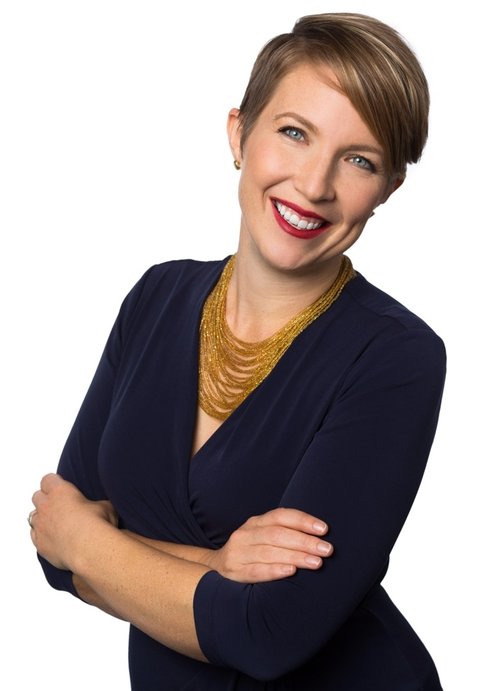
Prior to launching Solutions With Sonya, Sonya spent 13 years with Protected Investors of America, a boutique broker dealer and SEC registered investment adviser, where she rose up the ranks from executive assistant to COO to CEO.  Sonya’s been honored with Investment News 40 Under 40 award and a 2018 LinkedIn Top Voices Recipient, and she serves on the advisory board for the Investment News Women Adviser Summit.

We sat down with Sonya to not only talk about impact investing, but also to hear more about Sonya’s Do Better series, which highlights women’s stories in a predominantly male-dominated field and offers solutions pushing for systems-level changes across the financial services industry.


CNote: In your opinion, what are some of the challenges advisors face when talking about impact investing with other advisors?

Sonya Dreizler: First, is making sure we’re talking about the same thing when we say “impact investing.” That’s a hurdle that I see for a lot of people. Professionally, we need to have this vocabulary conversation. When you say “impact investing,” are you talking about ESG, and what does that mean? Are you talking about SRI?

I think advisors worry that that vocabulary hurdle will translate to clients, and it doesn’t. Clients put their trust in the advisor, and the advisor can choose the terminology that works best for them and stick with it. But this whole “what are we talking about when we’re talking about impact investing?” That conversation is a hurdle to any initial professional conversation in the space.

Aside from the vocabulary challenge, I often see advisors that are unwilling or not ready to bring up impact investing with clients.


CNote: Where do you think that reluctance comes from?

Sonya Dreizler: It’s different for each advisor, and to be clear, some advisors are adopting and embracing impact investing in tandem with their traditional practices. But, I think some advisors are worried that impact investing is more feelings based and less numbers based, which gives them pause.

Let’s take each of those separately. Regarding the numbers side, advisors can evaluate impact investments in the same way they evaluate traditional investments. The impact investments have the added value of being able to do social or environmental good. And now for the feelings part; I think advisors should embrace talking about feelings and values with their clients.

Clients are like all people—they want to be known, understood, seen and valued for their whole person. So, if you can have a conversation with clients about what’s important to them in addition to their  financial goals, it can deepen the relationship.

Another factor I see that contributes to reluctance to talk about impact investing is that when financial professionals and advisors present something to a client, they want to be the smartest person in the room. They want to know everything and have immediate solutions for what clients are asking for. Impact investing is an evolving area, so that can be a little bit tricky. If a client asks for something like a values tilt on their portfolio and it’s not something that the advisor is prepared to offer, that is a challenge. But as long as advisors are setting appropriate expectations about what values can be reflected in a portfolio, it’s OK to have that discussion.


CNote: What do you have to say to an advisor who says she or he isn’t hearing any interest in impact investing from clients?

Sonya Dreizler: It’s the advisor’s job to educate themselves and to find out what’s best for the client’s financial and personal goals. If advisors are waiting for clients to approach them about the topic to indicate interest, that’s not something that they’d do with any other type of investment. Advisors don’t expect a client to come in and ask for a 10 percent allocation to emerging markets.

Advisors should want to be the first ones telling their clients about impact investing or ESG. They should let their clients know that they’re thinking about impact investing, they’re knowledgeable and they’re ready to have the discussion if the client is interested.

One of the pieces of pushback I hear from advisors is, “well, my clients are not asking for this, so I don’t think that there is the same level of interest as all of those surveys show.” The recent Morgan Stanley survey showed that 85% of people surveyed were interested in sustainable investing. However, the thing with those surveys is that before the surveyor asks questions to the participant, the surveyor explains sustainable investing. They are explaining what it is first before they’re asking if there’s interest.

Advisors can do the same thing as those surveyors. They can even do it before they have impact investment solutions rolled out in their business. If they’re worried about the chicken and egg situation — that they don’t want to talk about it until they have something ready, but they don’t want to do all the work to create a solution until there’s interest — they can have the conversation before they have a solution ready. It might sound something like, “sustainable investing a quickly developing area, and is a topic our firms has been researching. We’re considering adding this if we have interest from our valued clients. Is this something you’d like to discuss?”


CNote: Do you have any ideas as to why people don’t feel empowered around investing?

Sonya Dreizler: There have been so many advances and tools that make investing easier, more accessible, and more democratic.For example, mutual funds, and being able to buy a basket of stocks instead of trying to buy one share of this and three shares of that and having to manage all the separate investments. Then ETFs allowed people to invest, inexpensively into indexes.  These vehicles have been great in many ways and benefited investors, but they’ve also obscured the process of what investing and many investors are disengaged from what they own. How can you feel empowered if you have no idea what’s going on inside that your portfolio? And then there’s the terminology. It can feel technical and overwhelming.


CNote: If you had a magic wand, what’s one thing you’d change about the industry?

Sonya Dreizler: Pass through shareholder voting rights in mutual funds, ETFs, and SMAs. I would love to see a way that proxy and shareholder engagement proposal voting could be opened up to the actual end shareholder in an easy and democratic way, and then the funds or managers can vote proxies if the end shareholder has chosen not to vote. That would allow the dentist with a $400,000 401k to vote and become more engaged and be more interested in what they’re investing in. They might push for change at a more rapid clip than mutual fund management would. I would love to see that.

Voting would remind a lot of people of what investing is. It’s Investing is owning a share of a company. You give your hard-earned money to that company to run their business in whatever way the management sees fit. As a shareholder, you  get to have a vote on some issues, and that vote can be powerful.


CNote: What has you most excited about impact investing in terms of innovation and future developments?

Sonya Dreizler: Impact investing can generally be broken down into these three categories: the E, the S and the G. As a community, we’ve done a pretty good job on pushing the E and an okay job on the G. We really haven’t pushed as hard on the S, and that’s the part that drives me.

I mean, you can’t really disentangle the E, S and G, right? But I want our investing community to really care about people. So even though we can’t disentangle them, looking at impact investing with a lens of S first and trying to focus on making the companies we invest in and the financial services companies we work in reflective of the communities that we live in, work in and serve is important to me.


CNote: Any ideas of how we can make that happen?

Sonya Dreizler: I don’t think most firms have put this on the front burner for a number of reasons. One of them being that it is hard to talk about gender, race, citizenship, class and personal inequities without feeling like maybe your own position as a fairly well-to-do person working in financial services is under attack.

I think the best thing we can do is be reflective and look in the mirror. We can start at our own companies first and work on creating inclusive workplaces that make financial services a better place to have a professional career for women, people of color and all other underrepresented groups. That means the workforce at all levels: employees, managers, VPs, executives and board members. Once we create diverse and inclusive workplaces in the financial services community, we’ll request and demand that of the companies we invest in. Overall, we’ll do better across the board because we’ll have so many different opinions represented.


CNote: Thinking about getting more underrepresented groups in the financial services industry, what are some of the successes you’ve seen in breaking down barriers?

Sonya Dreizler: It’s tough, and I can’t point to a ton of successes. Diversity programs have benefited women, but mostly white women. Those programs haven’t been representative of real diversity. I think white women need to do better at acknowledging our privilege and then focusing on advancing racial equity.


CNote: Why do you think financial services has remained a primarily male-dominated industry?

Sonya Dreizler: Two reasons come to mind. First, forced arbitration and NDAs keep a lot of sexual harassment and discrimination stories private and hidden, which means that women cannot work together and discuss what happened and identify where there are problems. That same secrecy protects companies that have regular ethical problems, and it protects the harassers. When harassment has to be kept a secret, the harasser can then go on to get a job at another company where nobody will know why they had to leave their last employer, which means they can go and harass somebody at the next company and the next company after that. That’s the pattern.


CNote: That’s a great segue to talk about the Do Better Series you started. Can you tell us about how that got started?

Sonya Dreizler: About a year ago, I was reading articles that had statistics about professional’s perspectives on the prevalence of gender-based harassment and discrimination in financial services. There’s a huge delta between how prevalent women think harassment is and how prevalent men think it is.

So many women who have these stories of harassment and assault and discrimination tell them to each other, but we don’t tell them publicly. The harassers are a minority of men and so most men are not harassing women or hearing about the harassment. So if not that many men know about it or have personally witnessed it, and women are experiencing it, but not talking about it, most men won’t know it’s happening. We women stay silent for our safety, or because we legally have to, or because we’re worried about career repercussions.

So, I thought that I wanted to write an article that explains why we don’t tell our stories and I put a request out on social media asking if any women would share their stories with me to share anonymously on their behalf. I was hoping to get two stories and I got 40 stories in 24 hours. That’s when I realized that this was something much bigger. Once I started to read all the stories, there were patterns and themes that came out over and over. I divided them into a series of articles focusing on the different issues that I saw, like how harassment and even assault run rampant at financial services conferences.


CNote: What do you hope men working in the financial services industry get from your Do Better campaign?

Sonya Dreizler: I want men to be more aware and to be better allies. That’s one of the goals, to have that sort of bottom up effect. I  want women to feel heard, and I want men to listen and really take in these stories. My other hope is that the series brings more systemic change. Financial services is a male-dominated industry and change will have to come from men. I’ll push for it, but I can’t make the change myself. I have to convince men to help me convince other men to change.


CNote: Pivoting slightly, but whom do you most admire in the financial services industry?

Sonya Dreizler: There’s a number of people really pushing the envelope on impact, particularly on the S part of ESG. Most of my professional experience is in the public equity space, so my heroes are from there. I really admire Geeta Aiyer’s work at Boston Common Asset Management, and Lisa Hayles, also of Boston Common. Rachel Robasciotti and Maya Philipson at Robasciotti & Philipson have an impressive way of thinking about screening, where they’re  gathering insight from the most impacted communities. Of course, CNote’s Cat Berman is someone I admire. And Rianka Dorsainvil for her excellent use of social media to engage clients. She’s a financial advisor, so her business and my business are very different, but I love her approach.


CNote: Last question: What are the top challenges and opportunities for advisors in impact investing?

Sonya Dreizler: Have the conversation if you’re not already having it, even if you don’t have solutions yet. I have tips and scripts on my website because it’s something that comes up often.

The other opportunity I see is with existing clients. When you’re doing SRI or impact investing, you can really deepen that client relationship, which in turn might foster referrals. By understanding the unique values that drive clients and tracking those values in a scalable way (I suggest a CRM field with the top 10 values you hear from clients), then when you see an event or an article or anything of interest pop up in one of those areas, you can send it out to clients who’ve expressed that value, even if you can’t invest precisely along those values.

So for example, if a client is really interested in ocean health and you see an article about ocean health, you can send it to them and say, “I saw this, and it made me think of you. I hope you’re doing well.” It’s showing clients that you’re listening and that you care and that you see them as a person, not just a portfolio. It might feel a little weird to do personal at a scalable level with CRM or email software, but it doesn’t have to be. The way you’re tracking values and sending it out is scalable, but the personal connection you’re fostering with the client is real.

One last thing is to take advantage of social media to the extent that you can under compliance and regulatory guidance. That might mean talking about some of the causes that are important to the advisor and those that are important to clients. Advisors can also share success stories showcasing the impact of an investment company. Those are especially nice pieces that advisors can share with clients so that clients can understand what’s in their portfolio. If advisors can  share those on social media, prospects can understand that deep connection possible between their money and their values.
 

By Change Makers Series, Migration V2

Change Makers Interview: Marco Vangelisti

When Marco Vangelisti, a member of a successful investment management team, peeked under the hood of the investment portfolio the team was managing, he was shocked to learn that some of the best-performing stocks in the portfolio were funding the destruction of hundreds of thousands of acres of orangutan-inhabited rainforest in Southeast Asia. Marco left his job in 2009 and began the process of liquidating his personal Wall Street portfolio. He reinvested in local and sustainable investments, and he started to learn more about the large systems that shape our society and shared what he learned.

Today, Marco is a highly sought after speaker, lecturer, consultant, and coach. He is a founding member of Slow Money and the founder of Essential Knowledge For Transition. As a self-identifying 100% impact investor, Marco is as equally passionate about aligning dollars and values as he is educating individual investors and financial advisors.

We caught up with Marco to talk about his journey, and we got a chance to discuss his thoughts on the future of impact investing, the power of individual investors, and the growing role of millennials.


CNote: How did you first become interested in impact investing?

Marco Vangelisti: I was part of a team that was managing a quantitative fund investing in emerging markets equities. We had developed quantitative models to predict returns and to control risk, and we were using an optimizer to build a very diversified portfolio. We were doing great — we had $20 billion under management, and one year we outperformed the MSCI emerging markets index by more than 10%. Most of our clients were foundations and endowments, including environmental foundations and they were very happy with our performance.

The interesting thing is that because we were managing a very diversified portfolio built in a quantitative way, we were not really focused on the individual stocks in the portfolio. When I looked at the best-performing stocks, I found a Malaysian palm oil company that had just destroyed a large section of the habitat of the orangutan in the Borneo. At that moment I realized there was this big disconnect between my livelihood and my personal values since I have always been a passionate environmentalist. What I realized is that we are trapped in a system that collectively provides us with the incentives to do things that we might not be aware of, and in the long term, might even undermine our long-term survival. It was very hard to connect those dots, even for an insider like me.

So, I actually left the industry and started looking at the large systems: how money and banking and economics and finance work. My belief is that we need to democratize the understanding of the functioning of those large systems because they act as the operating system of our society. I think everybody should understand enough about the design of those systems to be able to critique them and to feel empowered to demand changes.


CNote: How does that translate into your day-to-day work now?

Marco Vangelisti: In the last couple of years, I’ve been focusing on investor education and trying to convey to people that investments are not just generating returns, they’re shaping the world we live in. I developed a website that has a lot of free content for people to understand how those large systems work, and I also have a fee-based webinar series called Align Your Investments With Your Values, where I’m sharing my understanding of the financial system with individual investors looking to move towards non-extractive investments.

I’m also collaborating with a nonprofit called Money Quotient up in Portland, Oregon. They’ve been around for 20 years and are helping financial advisors become life financial planners, which is basically a blend between a life coach and a financial adviser. The idea is to work with clients to help them envision their best life, and then see how they can use their financial resources to bring it about. Together, we launched an online, self-paced course called Towards Aware and Values-Centered Investing.


CNote: How long did it take you to rebuild your portfolio to better align with your values?

Marco Vangelisti: It took me three years from the time I left the finance industry to actually get around to liquidate my positions and rebuild a portfolio that does no harm. That was my goal, but it’s not an easy task. Still, it’s something I embarked on, and it’s something I encourage others to do as well. In order to say I’m doing no harm, I need to know who is using my capital. Therefore, I’m not in the stock market and I’m not in mutual funds since it is very hard to assess the worldwide operations of publicly traded companies. This requires more work than simply hiring a financial advisor and putting your money in the usual mutual funds everybody knows about, although the financial advisers that took my course have embarked in the process of moving towards no-harm investing.


CNote: How would you frame the current status quo of our financial services industry?

Marco Vangelisti: I believe that if we avoid destroying the planet and go extinct as a species, we will look back at this time as we look back at slavery now. If you think about 200, 300 years ago, many of the wealthy people in society, many of the US presidents and those funding the Ivy League colleges were slave owners. People had a sense that it wasn’t ideal, but that’s how business was done, especially in the South, and slavery generated nice returns for plantation owners and their clients.

I think the same thing will happen when we look back at 2000, 2010, 2020, and ask how it was possible that capital was used to extract from and destroy the natural environment and communities around the world for the purpose of enriching the people that already had a lot. I think eventually if we learn to live in balance with nature and we change the course of society, we’ll get to that realization.


CNote: What are the trends you’re seeing in impact investing or changes you’ve seen over the last year or two that stand out to you?

Marco Vangelisti: The socially responsible fund was the first wave. Now I think we’re ready for the second wave. Maybe that’s community funds or more local funds and investments. I see a lot of potential thanks to the transfer of wealth to millennials. This young generation is very idealistic, and a number of millennials want to do the right thing. They’re not interested in finding a corporate job. They’re interested in starting a social enterprise to solve societal challenges through businesses, which is great. A number of them recognize that investing in large multinational corporations is something that they wouldn’t want to do, and so a lot of them are holding most of their money in cash.

Whatever money they save, they don’t know what to do with it. They don’t trust Wall Street. They don’t want to put it in the usual mutual funds or with the large multinational corporations and are asking for better options. I see a lot of hope because millennials who are either earning money or receiving inheritances tend to be conscious about what their investments are doing out there in the world. I think that there’s a growing pool of potential clients for financial advisors to tap into, especially if they develop some expertise in this area of no-harm and impact investing.


CNote: Do you think impact investing is a means to address inequality?

Marco Vangelisti: Traditional impact investing where people say they want their 8% return or that they want a market-rate return while doing good, will clearly not address the problem of inequality. If the economy is growing at 3% and the financial capital demands to grow at 5%, 6%, 7%, or 8%, what you’re seeing is more and more of the economic value being produced in society being sucked up by the owners of capital, regardless of whether you call that a mutual fund or you call that an impact fund. An impact fund that generates an 8% return is aggravating inequality because the people that have the money to invest in that are going to get, percentage-wise, more than the economy is growing. That means a larger share of the economy goes into the hands of those that have the capital. Actually, investing through the Kiva platform is a way to address inequality since those are zero-interest loans to people at the bottom of the pyramid internationally or to mostly minority or women entrepreneurs in the US.


CNote: How would you describe people’s awareness of the socially responsible investing movement?

Marco Vangelisti: In general I think people have a sense that the socially responsible investing movement started with people who were against the war, and who didn’t want to invest in weapons manufacturers. So a number of funds were created at the time, which was a good first step. Later funds were created to cater to investors concerned about the environment and those who did not want to invest in fossil fuels.  I think the demand for socially responsible funds has created some transparency and some reporting on the part of companies and maybe slightly better corporate behavior. But I think we need to go way beyond that.

The challenge is that most socially responsible funds (or ESG funds) hold stocks of publicly traded companies that need to deliver growing profits to support their stock price. There’s this imperative to continue growing profits; it is not sufficient to just be profitable. So, of course, this imperative leads to squeezing out or externalizing costs and eventually to cut corners.

Taking full responsibility for our agency in the world expressed through our investment is not easy, yet the time has come for us to do so. And I understand that that’s hard, given the level of opacity and intermediation in the finance industry – just finding out all the companies we are invested in through a single ESG fund might be quite a task. But the reality is that, if you look outside at the state of the world and where the environment or our society are going, it is clear that things are still deteriorating. That’s because we haven’t done enough to move the capital away from destructive activities.


CNote: Given how difficult it is to successfully “move capital away from destructive activities,” as you said, what’s some advice you have for financial advisors and investors who want to do better with their investing?

Marco Vangelisti: First of all, we have to recognize that we live in a system that makes it really easy for us to do the wrong thing. It’s almost impossible to be pure and not do any harm. What we’re trying to do is challenging and it is very had to be perfect. That’s why I like CNote because I know and approve what  CNote is investing in – CDFIs providing funding to people that have difficulty obtaining funding from the regular channels, such as minority and women entrepreneurs.

One thing you have to think about are the trade-offs. How strictly do you want to implement what you really believe in? In my case, I took an extreme position. I said I’m going to invest only when I know I’m doing no harm and it’s generally aligned with my values. It’s been a long process and it has not been easy. I’ve been at it for the last seven years. But, I can say now that 100% of my portfolio is aligned with my values and it’s doing no harm out there.

Moving to aware and no-harm investing is challenging for financial advisors to do that because it requires some new learning and possibly a rethink of their business model. Currently, they have a platform like Schwab or Fidelity, and they have access to all the funds and individual stocks through that platform which integrates their clients’ assets, generates reports and allows them to collect their management fees.  The investing options I’m talking about like RSF Social Finance and CNote aren’t seamlessly integrated into those platforms. Even though it’s not difficult, it’s still something new for advisors to have to familiarize themselves with. Yet  I see financial advisors as the agents of change in the finance industry. Through the demands of their clients, I think they can go to the next level and start demanding products and investments that are non-extractive and transparent.


CNote: Do you think that consumers really have to drive real, sustainable, prolonged change, or do you think advisors or asset managers can lead in this space? 

Marco Vangelisti: The type of changes that are required are very hard to implement for financial advisors and wealth managers alone. Financial advisors and wealth managers are not going to be the ones that initiate the change – the demand for no-harm investing has to come from the owners of capital, whether individual investors or institutions, saying, “I want to be mindful of what this capital is doing out there in the world, and I want to make sure that it does no harm.” But they have a key role in facilitating that aspiration of their clients.

For the last three years, I focused on educating individual investors, because they were the ones that really needed to know. The learning curve can be steep for someone who isn’t experienced in finance, and taking responsibility for one’s investments is something that only a few people are willing to do. But, by educating both the investors and the financial advisors that get it, I think that’s the ticket.


CNote: When you talk to younger folks or people that are maybe just starting to think about investing, what sort of advice do you give them?

Marco Vangelisti: Usually, what I suggest is to invest a small amount of money in CNote and in RSF Social Finance, and most importantly, to read the communications put out by those two funds. This is really to get their juices flowing and to say that there is a way to invest money that is positive for the world, and to encourage them to do more of that. Another reason why I send them to those two places is because I think the probability of losing principal in those two investments is very low. But not all impact investments are like that.


CNote: What’s your vision for socially responsible investing, and where do you think we’re heading long term?

Marco Vangelisti: My hope is that we are going to move toward more local and aware investing. In the next decade, I think we’re going to see a massive realignment of financial values. I do believe that financial markets are completely manipulated at this time and that there is way too much in actual capital out there. A lot of people are not aware, but basically a lot of it is fictitious capital that is going to go away, and I think that will awaken people to the fact that maybe they need to invest in things they really understand. That means investments that are closer to home or through trusted intermediaries like RSF Social Finance and CNote, not Wall Street and large corporations. And I think there will be a lot more innovation to bring about more opportunities to invest in a way that is transparent and is more local and does no harm.


By CDFIs, CNote, Migration V2

CNote Partners with Natural Capital Investment Fund

Fintech firm focused on financial inclusion partners to become new capital source for loan fund serving central Appalachia and the Southeast.

CNote has entered into a partnership with the Natural Capital Investment Fund (NCIFund) that will allow NCIFund to access new investor capital aligned with NCIFund’s mission of catalyzing environmentally and socially responsible business development, sustainable jobs, and wealth creation in rural, minority and low-wealth communities.

This partnership builds on CNote’s mission to create a more inclusive economy for everyone by enabling investors of all sizes to deploy capital with mission-aligned organizations while generating competitive financial returns and measurable social impact.

As CNote aggregates increasing investor demand seeking socially responsible investment opportunities, it partners with leading Community Development Financial Institutions (CDFIs) like NCIFund. CDFIs are federally-certified community-focused lenders that enable transformative economic development in their communities, providing funding to small businesses, affordable housing development, and other projects in communities that often lack adequate access to financial resources.

NCIFund’s focus on locally owned triple-bottom-line (TBL) small to mid-sized businesses in central Appalachia and the Southeast aligns with CNote’s mission and matches growing investor demand to support rural communities. CNote co-founder Yuliya Tarasava remarked, “We’re excited to have NCIFund as a partner; they have an amazing pedigree of driving measurable change in the communities they serve. As more investors look for ways to invest in rural America, NCIFund presents an opportunity to do that in a very intentional and sustainable way.”

Founded in 1999 by The Conservation Fund, in partnership with the West Virginia Small Business Development Center and the Appalachian Regional Commission (ARC), NCIFund was created to address the lack of access to capital for small businesses and farms that responsibly steward natural resources and provide vital community services. NCIFund now serves West VirginiaNorth Carolina, and the Appalachian regions of surrounding states, where it has lent over $70 million to 400+ companies, generating more than 5,300 jobs. Over 50% of NCIFund’s borrowers are women or people of color.

“We rely on capital from impact investors to help us increase our support for women business owners, entrepreneurs of color, and the underserved and rural communities we work hard to serve,” said Marten Jenkins, CEO of NCIFund. “So, we’re very pleased to become a CNote partner. CNote is an exciting way for NCIFund to connect with investors who share our mission.”

About CNote

CNote is an award-winning, first-of-its-kind financial platform that allows anyone to make money investing in causes and communities they care about. With the mission of closing the wealth gap, CNote directs every dollar invested toward funding female- and minority-led small businesses, affordable housing and economic development through its nationwide network of CDFI community lenders.

About The Natural Capital Investment Fund

The Natural Capital Investment Fund (NCIFund) invests in enterprises that promote a healthy environment and healthy families in Central Appalachia and the Southeast, catalyzing environmentally and socially responsible business development and wealth creation in rural, minority and low-wealth communities. The fund meets its mission as a federally certified community development financial institution (CDFI) by lending to and assisting triple-bottom-line enterprises that promote equity, protect the environment and grow the economy, including: healthy local food and specialty agriculture, renewable energy and energy efficiency, eco- and heritage tourism, child and adult day care, primary care providers, and small town main street redevelopment.

View Full Release