Monthly Archives

December 2019

By Borrower Stories, Migration V1, Wisdom

Meet Tysh Billingsley, The Cancer Survivor Who Brought Her Dream Business To Life

Before Tysh Billingsley was an entrepreneur, she was a dreamer.

Literally.

Tysh’s idea for her business, Finale, a popup wine and food experience centered around local art and music, came to her in a dream. According to Tysh, her dream was so vivid and full of sights and sounds that as soon as she woke up, she wrote it all down. It captured everything: her eye for detail, her appreciation for fine food and drink, and her desire to create memorable experiences for others.

Never in her wildest dreams did the Birmingham, Alabama native and long-time flight attendant expect to become an entrepreneur. Unfortunately, that’s when something else unexpected happened.

Two days after her business dream, Tysh was diagnosed with breast cancer.

“As a spiritual woman, I said ‘oh my God, why would you give this great, amazing dream to me, only to snatch the feeling and excitement out of me two days later?’ I realized that I needed something to live for, and I had to fight for that.’”

According to Tysh, unlike others who are diagnosed with cancer, she didn’t have children or parents or a spouse “to live for,” as she put it. Instead, Tysh had the dream of her business, and the desire to make that dream a reality.


A Dream Worth Fighting For

Luckily for Tysh, she wasn’t alone in her fight to get Finale off the ground. She started to ask business owners she knew in the community about how they got started, and about what she needed to know.

That’s how she got connected with CO.STARTERS, a program that equips aspiring entrepreneurs with the insights, relationships, and tools they need to turn their business ideas into action. Tysh completed the 10-week program, which she said helped her to network and to get on the right path as a business owner. Reaching out to her local business community is also how Tysh learned about TruFund, a Community Development Financial Institution (CDFI) that invests in small businesses in Alabama, Louisiana, and New York. CNote partners with CDFIs like TruFund in communities across the country, providing business coaching to local entrepreneurs like Tysh.

Tysh completed TruFund’s six-week EmpowHERment Program, an initiative to provide women with the requisite financial solutions, education, and hands-on business advisory services they need to succeed as entrepreneurs. For Tysh, the business coaching was invaluable. “They showed me there were other ways of doing something,” she said. “They gave me ideas, helped me with my business concept, and they got the ball rolling on my thought process. They’re showing female business owners how to take our businesses to the next level.”

Once participants complete TruFund’s program, they’re encouraged to seek a loan through CNote’s Wisdom Fund collaboration, an impact investment opportunity that increases capital access and lending for women-owned businesses. That’s where Tysh is today: determining what she needs to do to get to a place where she’ll be eligible for a small business loan. That included taking a branding, marketing, and technology class hosted by TruFund.

“TruFund showed us how to do everything from A to Z when it came to business,” Tysh said. “That includes motivation. They really encourage us to continue doing what we’re doing, because being a business owner gets hard. Your heart gets heavy and you want to throw in the towel and say ‘this ain’t worth it.’ So having that support is really important.”

Just The Beginning

Tysh didn’t throw in the towel on Finale after her diagnosis. Instead, she launched her business in 2016, and she’s been steadily growing her company ever since. Better yet, today, she’s cancer free.

Over the past few years, Tysh has hosted more than 10 ticketed Finale events in Alabama, Ohio and New Jersey (because she still works as a flight attendant, she’s able to host pop-up events in cities other than Birmingham). The events typically last for three hours and include curated wine and food pairings alongside live music or art. To make each Finale popup happen, Tysh works with local chefs, servers, musicians, artists, and venues. Creating a cascading effect on the host communities that reaches beyond Tysh and Finale.

Although Tysh faces challenges like any small business owner, those struggles haven’t dampened her enthusiasm. Her long-term goals include having a brick-and-mortar tasting room in Birmingham where “everybody can walk in from the street and feel a little bit of luxury every now and then,” as she puts it. She’d also like to be able to host events in the space, and one day, she wants to have multiple Finale locations across the U.S.

It’s not an unattainable dream, especially considering how far she’s taken Finale already. However, to solidify her driving force, Tysh baked her mantra into Finale’s tagline: “where the end is just the beginning.”

“When people get breast cancer, you think this is the end. Nothing else is left. But for me, it was just the beginning of my life. That slogan not only represents desserts and the end of the night. It means much more to me. Cancer catapulted me to the next phase of my life. I thought it was my end, but it was just my beginning.”

Learn More

  • Finale 
  • TruFund – is a 501 (c) 3 certified Community Development Financial Institution (CDFI) headquartered in New York City with field offices in Alabama and Louisiana. TruFund tailors its financial and technical assistance to the unique needs of each site—from contractor mobilization lending in New York and Louisiana to rural Black Belt initiatives in Alabama.
  • CNote – Interested in helping create another story like Tysh’s? CNote makes it easy to invest in great CDFIs like TruFund, helping you earn more while having a positive impact on businesses and communities across America.
By Impact Investing, Migration V1

Positive and Negative Investment Screening Explained

If you have explored socially responsible investing (SRI), then you might also be familiar with the concept of investment screening.

Socially responsible investing, a form of impact investing, is a strategy used to align investments with social goals.

Investors understand that their money can produce positive outcomes in more than just a financial sense by achieving both financial growth and positive social change. Investment screening is used to filter out companies or organizations that do not meet investors’ standards, and instead allocate capital to those that do.

Positive and negative investment screening is used to distinguish between different organizations based on how restrictive investors would like their investments to be. Positive screening identifies and focuses investments into companies that are considered top performers based upon chosen criteria. Alternatively, negative screening looks to exclude companies that perform poorly on environmental, social, and corporate governance (ESG) criteria and removes them from investment portfolios. Understanding some of the different approaches to socially responsible investments can help you to learn how your portfolio is managed, and which investment strategies best fit your objectives.

What is Impact Investing?

Impact investing is a way to invest your money with the intent to bring about some socially desirable outcome with the expectation of a financial return. 

CNote specifically defines impact investing as deploying capital with the aim of creating some measurable positive social outcomes with the expectation of financial returns. Like your vote, your dollar is powerful. Whenever you give money to an institution, whether in the form of an investment or a transaction, you are supporting their mission – whether you morally agree with it or not. It’s that simple.

Of course, there is some subjectivity when it comes to what it means to do good. Something that one investor believes to be a good cause may not be important to another investor. Overall, the goals of impact investing generally reflect popular social and political opinions of the time. In the mid-twentieth century, this included a focus on civil rights, women’s suffrage, and anti-war efforts. Nowadays, common causes people look to support through the power of their investments are environmentally sustainable initiatives, increasing economic opportunity for minority or underrepresented communities and ending world hunger.

There are three key components to impact investing: investment with the intention to do good and the expectation of financial return all while creating measurable impact. Measuring the impact of one’s investment is a central tenet of impact investing. If you are investing to make a difference, you should utilize measures to understand the true impact your investment is having.

What is Socially Responsible Investing?

Socially responsible investing (SRI) is a strategy that considers specific investor values when choosing organizations to invest in.  Sometimes referred to as Sustainable, Responsible, Impact Investing, SRI Investing involves investing in companies that are engaged in ethical and socially conscious fields. Also known as ‘green investing’ or ‘ethical investing,’ SRI has become a popular way for investors to support causes they believe in while earning positive financial returns.

Much like impact investing, there is a level of subjectivity when it comes to socially responsible investments. In general, SRI indexes or mutual funds look to invest in organizations that support environmental and social causes. They typically avoid companies that deal with alcohol, gambling, tobacco, and weapons.

Why Engage in Socially Responsible Investing Practices?

People invest in SRI indexes and funds for a variety of reasons. An investor may be driven by strong personal values that guide their investment decisions. If investors are dedicated to green living, they may want to invest in companies that pass ESG criteria for green companies. A company or investor may pride themselves in supporting organizations that celebrate diversity. They may pursue investments in companies that champion these initiatives as a way of improving their own ESG profile.

We are seeing more often than ever before that clients and shareholders are demanding that companies take action to improve their own ESG standing, like through investing in SRI opportunities. Shareholder activism has forced organizations to reevaluate their own practices and invest in causes that their shareholders value.

Does SRI Result In Lower Financial Returns?

You may have heard that committing to socially responsible investing may result in lower returns. However, that is often not the case.

Consider the Domini 400 Social Index, which is essentially the S&P 500 for socially responsible investing. In a study from Morningstar and MSCI that compared the index total returns from the year 1990 to 2008, it was determined that the return and risk characteristics were nearly identical for both indices. In fact, the Domini 400 Social Index slightly outperformed the S&P 500.

As the tide changes towards more socially responsible investing, companies are learning that raising their ESG standards can earn them more investors and a stronger client base. Consumers are looking for companies that reflect their values now more than ever. Socially responsible investing has built a bridge between enacting positive change and growing wealth.

The Difference Between SRI and Impact Investing

While SRI and impact investing both seek to enact social change and produce wealth, they differ in their need for measurable change.SRI is concerned with deploying investment dollars in a way that is responsible and positive. Impact investing requires that the change be, as the name implies, impactful. A good way to understand the difference between SRI and impact investing is that SRI can simply stop at “do no harm” while impact investing seeks to proactively “do good” with investments.

Screening and Socially Responsible Investing

While impact investors seek to do measurable good, socially responsible investors seek to support causes that align with their views and avoid causes that they find undesirable. This is done through a process called screening.

Investment screening is the process of determining whether an organization’s values align with that of the investors. In today’s market, screens help identify firms based on environmental, social and corporate governance (ESG) criteria.

When evaluating companies based on environmental factors, a screen may take into account the amount of waste they produce, greenhouse gas and carbon outputs, raw materials used in production and how materials are sourced.

Companies evaluated based on social standards will typically look at the health and safety of workers, gender equality within the company, and diversity within the workplace. However, sometimes the assessment of socially responsible practices does not stop at the company themselves; Some fund managers will even evaluate the workplace practices of suppliers to ensure that they pass the screens as well.

Governance standards refer to how the business conducts itself. These screens will typically test for corruption, instances of retaliation, scandals, or even the compensation differences between executive members and entry-level workers.

There are two forms of investment screening: positive screening and negative screening. Screens are essentially filters that define what is an acceptable investment. They help to identify companies that may have risks that are not recognized by traditional fiscal standards. For example, if an analyst would like to screen for companies that are cruelty-free, this would set a clear screen parameter for investment opportunities.

The History of Screening

Investment screening was originally used by religious investors who were concerned about investing in industries that they found sinful. This was meant to exclude companies that were involved in industries like weapons manufacturing, alcohol and tobacco companies, and gambling operations.

Eventually, this shifted from just being utilized by religious investors to also being used investors who were interested in using their money to advance their social beliefs. This especially included women’s right to vote and civil rights in the early 20th century.

Investors also used screening to divert funds from companies that they found did not represent their values. In the 70’s and 80’s, investors used divestment as a way to negatively screen companies that benefitted from South Africa’s Apartheid policy. If a company benefitted from apartheid, investors pulled all of their investments out of the company. The lack of economic support helped to aid in the breakdown of apartheid.

What is Negative Screening?

Negative screening, or exclusionary screening, is one of the most basic methods of separating socially responsible investments from those that are likely to have a negative effect on society.

Negative screening is much less restrictive than positive screening. It simply excludes investments in companies that actively work against the investor’s values, such as organizations with a history of international bribery or corruption. Effectively, this process works to remove investments in entities that are deemed as having a negative impact on society or the environment from the investor’s portfolio. For this reason, negative screens help to embody the “do no harm” initiative of impact investing.

Early socially responsible investors used negative screens to weed out companies in ‘sin industries’, such as alcohol or gambling. The negative screening process has evolved to also exclude companies that do not meet diversity standards, emit large amounts of greenhouse gases, or engage in corrupt business practices.

Advantages

Negative screening is the most widely used process of identifying targeted investments for a reason; it’s incredibly inclusive.

Investors hesitant to adopt SRI may consider negative screening as it does not require companies to go above and beyond to be included in an investment portfolio. It weeds out the worst of the worst based on the particular screening criteria used and determines the rest of the companies to be acceptable. This can be beneficial to investors who are worried that SRI may be too exclusive.

Negative screens can also prevent investments into specific countries. Many exclusionary funds will exclude government bonds from countries that are known as human rights abusers. This not only prevents you from supporting practices that you find unacceptable, but it can also prevent you from investing in governments that are particularly egregious.

Drawbacks

One of the largest criticisms of negative screening is that it doesn’t work to support investments that align with an investor’s values. Negative screens work solely on eliminating investments that go against investor values. They do not place companies that support investor values at any particular advantage. By simply avoiding companies who actively work against investor values, negative screens do little to elevate the companies that actively do good. It is widely thought to have no tangible impact, as another investor (that is not focused on SRI) will likely invest in those stocks.

Examples

The most basic form of a negative screen is to avoid investments in ‘sin’ industries. This is also one of the earliest forms of negative screening. In the 1700’s, religious investors in the U.S. refused to place investments in tobacco, alcohol or gambling ventures. Even today, there are funds that screen based on specific religious doctrines.

Another example of a negative screen would be to screen for companies that have had any sexual harassment allegations in the past six years. Assuming that the fund is regularly rebalanced, any company that has not had a sexual harassment allegation in the past six years would be included or remain in the fund. A company that has had a sexual harassment allegation would be eliminated from the fund entirely.

What is Positive Screening?

Sometimes a fund manager may find that negative screening tactics may leave quite a few investments to choose from. This is where positive screening can be helpful.

Positive screening, or as it is sometimes referred to, ‘best-in-class screening’, is a process that identifies companies that are actively making contributions to social or environmental change. This enables investors to screen for and support practices that they find impactful.

Positive screening techniques work to identify and highlight organizations that are actively functioning to further environmentally sustainable and positive social practices, rather than simply avoiding bad behavior. Companies shown to have a positive impact are supported, while those who simply meet the status quo may fail the screen.

Advantages

Positive screening often looks to include only the best companies in a given impact category in the fund or portfolio. 

Best-in-class screening also encourages companies to compete with each other for investment dollars. When investment funds are based on the environmental, social or governance performance of companies, this incentivizes companies to compete with one another to create more impactful change. Positive screening not only rewards companies that do well, but it encourages industry peers to further advance their positively impactful corporate practices as well.

Drawbacks

The one major downside of positive screening is that it can be too exclusive. Investors interested in diversifying their portfolio may have trouble doing so through a positive screen. Depending on how rigorous their screening process is, it can sometimes lead to just a few companies making the cut. However, if the screen is too lenient, it can allow for companies that aren’t necessarily committed to the given cause squeaking through. This can make the positive screen feel like a moot point altogether.

Examples

Many investors are indicating that it is not enough to simply avoid harmful investments. They are interested in investing in companies that actively support their values. A common positive investment screen is for companies that create a certain amount of clean revenue. For a screen that required at least 75% clean revenue production, then only companies that met that hurdle would make the cut.

How Does a Fund Manager Screen Investments?

Because screening is subjective to the investor’s values, finding a fund or portfolio that closely matches your values is essential. But how does a fund manager actually screen its investments?

The screening process is usually implemented in one of two ways: a third-party investment manager or the use of standard restriction screens from a third-party data vendor. In essence, a firm will either outsource the screening process or they will do it themselves based on third-party data.

A firm will audit funds or portfolios at specific intervals, often quarterly or annually. Investments that do not meet the screening criteria at the time of the audit are removed from the fund or portfolio altogether.

Investors must be careful to review the screening criteria closely. A fund may say that they use environmental, social or corporate governance screens, but they may not be as rigorous as an investor would like. Understanding which causes are important to the investor and how restrictive the investments should be is important when considering a firm’s screening methods.

Is One Form of Screening Better Than the Other?

There is no one form of screening that is inherently better than the other. Because positive and negative screening works in two different ways, it is widely agreed that a combination of both methods will lend itself to the most well-rounded screening process.

It is important that the investor has a clear idea of their SRI goals and personal delineations for success to be sure that the chosen investments align well with those ideals.

When Screens Get It Wrong

Just because a company passes a screen doesn’t mean they are perfect.

Screens are merely tools that are used to help a fund manager or research department quantify what it means to be a socially responsible investment. This does not always mean that the screens are particularly rigorous, or that the company being screened is entirely ethical. A company could pass on one screen but fail another.

For example, consider a fund manager that is tasked with identifying companies that are considered low waste by environmental criteria. A company may meet the low waste requirement but also be in the midst of a sexual harassment scandal. This company would pass the positive screen. If the fund manager also had a negative screen to exclude companies based on sexual harassment claims, this company would fail. It all depends on what the investment opportunities are being screened for.

Final Thoughts

Socially responsible investing attracts investors that are not only interested in turning a profit; They are also looking to support their community, the environment, and causes that they are passionate about to thrive. Investment screens help analysts identify which companies will gain investor’s support. They offer a standard by which investors can judge companies and hold companies accountable for their values and actions. Understanding screens can help you identify investments and help you feel confident that you are supporting a good cause.

By CDFIs, CNote, Impact Investing, Migration V1

Making an Impact: How to Invest in Community Development Financial Institutions (CDFIs)

Stacked coins growing a return

Large banks and foundations have been investing in community development financial institutions (CDFIs) for decades. But until recently, investing in CDFIs was challenging and usually limited to all but experienced large banks, foundations, and some high-net-worth investors. Now technology platforms like CNote are allowing investors of all types to easily deploy capital across a diverse pool of CDFIs. 

Many communities across the country are underserved by traditional lending institutions. CDFIs make a social and economic impact in disinvested communities by providing affordable financial products and services, such as mortgage financing for first-time homebuyers, commercial loans, and small business lending. 

CDFI financing in underserved markets has shown that community development financing can be profitable and that CDFIs are valuable partners to both their investors and borrowers. Their place-based development strategies have played a critical role in effectively building community wealth.

What are CDFIs?

Community development financial institutions include mission-driven banks, credit unions, loan funds, and venture capital providers. Through CDFIs’ efforts, billions of dollars have been leveraged for investment in communities left out of the economic mainstream. With limited access to affordable credit and capital, residents of low-income communities are locked out of starting and growing a business, purchasing a home, and having access to retail banking and social service facilities. 

Money growing in community soil

CDFIs’ primary mission is focused on supporting economic growth in the communities they serve. CDFIs fund small, often minority-owned businesses, affordable housing, volunteer organizations, and services essential to revitalizing low-income neighborhoods. CDFIs are of critical importance in safeguarding the ability of all Americans to share in the prosperity and innovation of our country.  

CDFIs are certified by the U.S. Treasury Department, and most banks supported by community investments are certified CDFIs. Currently, the number of CDFIs continues to increase. There are over 1,000 CDFIs certified by the U.S. Treasury’s CDFI Fund. CDFIs can be found in every state and the District of Columbia, serving both rural and urban communities. As of 2019, certified CDFIs hold $136 billion in assets. 

The history of CDFIs

Historically, mainstream banks and financial institutions viewed low-income and minority communities as too risky for investment. Banks took part in the practice of redlining, drawing actual red lines on physical maps to exclude disadvantaged urban and rural neighborhoods from loans and financial services. 

Gale Cincotta, co-founder of National People’s Action

Gale Cincotta, co-founder of National People’s Action, instrumental in the passage of the CRA, courtesy of Community-wealth.org

The CDFI movement traces its roots to community advocates who sought to end redlining practices and re-direct capital back into underserved areas by forming community-controlled banks. The federal government also sought to address redlining and alleviate racial discrimination through The Community Reinvestment Act of 1977 (CRA). 

The CDFI industry really began to take shape in the 1950s and 1960s. During this era, through its “War on Poverty” campaign, The Johnson Administration launched community development corporations (CDCs) to serve urban and rural poor communities. The foundation for the modern CDFI industry was laid by the successes of many of these early CDCs.  

In the 1970s, community-controlled banks were formed, such as South Shore Bank in Chicago (1973) and the Santa Cruz Community Credit Union (1977). 

CDFIs also expanded their funding sources by reaching out to private organizations, particularly religious institutions and wealthy individuals. And many community development loan funds were launched with federal funds from the Department of Housing and Urban Development, the Economic Development Administration and the Department of Agriculture. 

Washington DC capital government building

Credit unions expanded significantly in the 1990s when the government provided new funding and encouraged conventional funders to do the same through revised CRA regulations. In 1994, the Clinton administration enacted the Riegle Community Development and Regulatory Improvement Act. This act established the CDFI Fund “to promote economic revitalization and community development through an investment and assistance program for community development financial institutions.”

In 1995, the Clinton administration also revised CRA regulations that explicitly recognized loans and investments in CDFIs as a qualified CRA activity. The growing record of success of CDFIs has inspired confidence in the industry and continues to attract new sources of support and funding.

The different types of CDFIs 

Although CDFIs share a common mission of community development, they have a variety of organizational structures and lending goals. Each type of CDFI has different investment opportunities, and financial products and services it provides to customers in low-income communities.

Here are the four basic types of CDFIs: 

  • Community development banks

CDFI-certified banks are for-profit corporations with an economic development mission and community representation on their board of directors. These federally insured banks are organized like traditional banks but are required to have at least 60% of their financing activities targeted to low- and moderate-income communities.

  • Community development credit unions 

CDFI-certified credit unions are federally insured financial cooperatives that are designed to provide financial services to individual members of the credit union. The National Credit Union Administration (NCUA) charters, supervises and insures federal credit unions. The deposits in these institutions are insured by the NCUA up to the maximum allowed by law. Many CDFI-certified credit unions have also received designation as “low-income” credit unions by NCUA. This designation allows these institutions to accept non-member deposits and secondary capital.

  • Community development loan funds

CDFI-certified loan funds lend to build local businesses, affordable housing, and community facilities. Loan funds’ borrowers are small businesses, nonprofit organizations, charter schools, individuals, and organizations involved in community development projects. Loan funds also provide financial counseling to individual and business borrowers. 

  • Community development venture capital funds

CDFI-certified venture capital funds pool investor money to make equity investments in private operating companies that yield financial returns while accomplishing community development goals. They also provide equity and management expertise to often minority-owned small businesses that have the potential for rapid growth.

CDFI banks and credit unions are depository institutions regulated by federal agencies. CDFI loan funds and venture capital funds are not federally insured and not subject to federal banking regulations. 

Where CDFIs get their capital

Banks, the government, foundations, and individual investors are the main sources of funding for CDFIs. The CRA encourages financial institutions to fulfill their CRA requirements by investing in CDFIs. This capital, in turn, funds the capital needs of the CDFI and its community. A CDFI’s success is measured not just on their financial performance, but also by their impact on underserved communities.

Depository CDFIs, such as community development banks and credit unions, get capital from customers and non-member depositors. CDFIs work in partnership with conventional financial institutions to guide private investment into distressed communities, either through direct investment in the CDFI or through lending, investment, and other services.

The CDFI Fund is a crucial source of support for CDFIs and offers capital grants, equity investments, and awards to fund technical assistance and organizational capacity-building. CDFIs apply for funds through a competitive process that often requires the organization to provide a one-to-one match of non-federal funds to receive financial assistance. 

The CDFI Fund also rewards banks for making investments in CDFIs and distressed communities through its Bank Enterprise Award Program. The New Markets Tax Credits Program encourages private sector investment by offering tax credits for qualified community development investments. 

The role of CDFIs in community finance

CDFIs gather specific knowledge about the communities in which they do business. They create strong relationships with their customers and community leaders. This translates into a willingness and commitment to spend time on specialized programs that are often too time-consuming or costly for traditional financial institutions to implement.

For example, many CDFIs offer small business loans that have lower eligibility requirements than most traditional bank loans when it comes to time in business, credit score, collateral, and annual revenue. Others make financial accounts available to customers with limited or poor credit history. In contrast, traditional institutions tend to offer only a few programs that target the broader market.

Man working at a small business

Rebuilding underserved communities and making loans to those with limited or poor credit histories requires more than access to conventional loans. It demands lending guidelines that can adapt to the needs of borrowers, the acceptance of unconventional collateral, and educating, training, and assisting potential borrowers on how to effectively use credit and capital.

CDFIs enable those who are economically disadvantaged to become self-sustaining participants in their own future. CDFIs are community pioneers, leading the way in investing in distressed neighborhoods and bringing everyone into the economic mainstream as important contributors.

How community foundations partner with CDFIs

Foundations employ CDFIs’ expertise in everything from sourcing to underwriting. Foundations have even developed their own CDFIs. A notable example is New Hampshire Charitable Foundation that started the New Hampshire Community Loan Fund in the 1980s.

Since 2000 or so, community foundations have been facing competition for donors from commercial banks and investment firms managing donor-advised funds, as well as crowdfunding platforms and giving circles. At the same time, according to this Democracy Collaborative report, community foundations have begun paying more attention to structural poverty and what they can do about it.

As a result, some community foundations that have focused on a passive approach to making grants, have begun experimenting with becoming more proactive through partnering with and investing in CDFIs.

 

For example, CNote recently worked with the Sierra Club Foundation to figure out how their portfolio could help advance social justice as well as their core environmental goals. CNote made it possible for the Sierra Club to meet its objectives through place-based investing. After finalizing the investment terms, the foundation was able to deploy capital to its targeted communities and connect partner CDFIs on the ground with local Sierra Club leaders to boost momentum for their Ready for 100 Campaign.   

With economic factors playing a key role in most social missions, CDFI’s insights can be very informative to the strategies of thematic and place-based community foundations.

Why community foundations invest in CDFIs

CDFI investments work well for foundations that don’t want to deliver loans and manage risk but want to make an impact by directly investing in local businesses.

The CDFI is staffed with loan officers and has built all the systems needed to market and manage a loan portfolio. Their staff have intimate community relationships, so they’re successful in finding the high-impact transactions that foundation investors want.

CDFIs offer foundations a way to cushion financial risk by spreading the foundation’s investment over a diversified portfolio of loans. They also monitor and manage risk, and hold loan loss reserves. These costs are factored into the CDFI business model and interest rate that CDFIs offer investors.

Foundations who care about a specific geographic region invest in CDFIs for both a financial return and social impact in their communities. Foundations are becoming more involved in CDFI and impact investing as a complement to their social and environmental work. 

The benefits of CDFIs for individual investors

Awareness and interest in community investing options have grown. Americans have shared a difficult financial experience in recent years that has heightened the awareness of larger numbers of low-income families needing help.  

Stock exchange board

The financial crisis also encouraged some distrust of financial institutions whose risky practices helped induce the crisis. These developments have motivated some to invest more in local and community-based institutions.

The positive effect that CDFIs have on their communities can not be underestimated. Local community-based organizations make the best decisions about how to meet their community’s needs, and CDFI activity also brings responsible first-time homeowners, locally-owned businesses, neighborhood facilities, and other benefits to communities beyond just the financial bottom line.

When you invest in community development financial institutions, you can:  

  • Align your investments with your values

Because CDFI investing can make positive changes for those who need it most while generating financial returns, investors can support the causes they care about while putting their capital to work. CDFIs generally offer a modest, fixed rate of return depending on current interest rates and the length of the investment.

  • Increase your portfolio stability 

A Morgan Stanley study, of over 10,000 equity mutual funds over seven years, found that, on average, impact investing funds had lower volatility than comparable non-impact funds.

  • Expand your community network 

CDFIs offer investors the chance to truly invest in the small businesses of “Main Street America.” The greater impact investing community includes policymakers, entrepreneurs, human rights activists, and development experts, all dedicated to utilizing capital in pursuit of tackling important societal issues. 

How to invest in a CDFI

The most common type of CDFI investment is in a community development loan fund. Loan funds provide the security of pooling capital with other investors and spreading risk within a diversified portfolio. 

CDFI loan funds are also increasing their presence and sophistication in the community investment sector. Several funds now have formal offerings and are registered to offer their notes in multiple states. Others operate more informally and reach out to investors as an extension of their local fundraising efforts.  

Here are a number of CDFI note programs that are available to retail, accredited, and institutional investors in states where they’re offered:

CDFI note programs

  • The Impact Note – Enterprise Community Loan Fund 

The Impact Note offered by the Enterprise Community Loan Fund allows you to invest in your community while earning a fixed return of 2.5% for a 5-year term. With your minimum investment of $25,000, you support projects and businesses that are solving essential community development issues, such as affordable housing, health services for the homeless, quality children’s education, entrepreneurial funding, and healthy active seniors. The Enterprise Community Loan Fund has over 30 years of investing experience and is a treasury-certified CDFI that is rated by AERIS and listed in ImpactAssets50.    

  • The LIIF Impact Note – Low Income Investment Fund

The LIIF Impact Note is an easy way to invest in the communities you care about while earning a competitive return of 1-4%. This note offers a flexible commitment of 6 months – 10 years with a minimum investment of $50,000. The annual percentage rate is 3% for a 5-year Impact Note. The note is available to non-accredited investors on ImpactUS, a broker-dealer “impact marketplace.” 

  • RSF Social Investment Fund Note – RSF Social Finance

RSF Social Finance is among the first to create widely available notes for the “retail” market. It’s open to residents of 48 U.S. states, the District of Columbia, and Puerto Rico, excluding Arkansas and Washington. The note requires a minimum investment of $1,000 and offers a 90-day term, a current interest rate of 1.25%, and is annualized and reset at the beginning of each quarter.  

  • Community Investment Notes – Calvert Impact Capital

Calvert Impact Capital’s Community Investment Notes are a “fixed income product that invest in a global portfolio of intermediaries, projects, and funds that finance mission-driven organizations.” Calvert pools investor funds and lends them to a diverse group of CDFIs, affordable housing developers, and international microfinance organizations. 

Although not solely a CDFI investment, these notes offer a financial return of 3% for a five-year commitment term. Calvert’s notes are processed and distributed electronically through conventional investment platforms for all types of investors. Community Investment Notes can be purchased online starting at $20 or through a brokerage account, application or check for a minimum investment of $1,000. 

  • The Low Income Investment Fund (LIIF) bonds

Low-Income Investment Fund (LIIF) is a San Francisco-based CDFI that has been investing in low-income communities for over 30 years. Its loans support affordable housing, high-quality schools, child care centers, health centers, and other community facilities that benefit low-income communities.

While buying bonds may have higher barriers to entry than notes, if you’re able to do so, you can invest in a diverse portfolio that helps achieve both competitive returns and a measurable impact on struggling communities. LIIF’s capital is critical to its borrowers who are mission-driven developers and nonprofits. Recently, LIIF announced its first public debt offering with a $100 million Sustainability bond issuance. The bond issuance allows LIIF to provide more stable, lower cost, and longer-term capital to community organizations.

  • CNote – The Flagship Fund

CNote acts as a bridge between individual investors and CDFIs, pooling small investments and funneling them to partner CDFIs. The Flagship Fund accepts investments from investors of any net worth, so you can get started with just $5. With an online CNote account, you can invest your savings in certified CDFIs that are working to improve community development. You can earn 2.00% with only a 30-month term and flexible quarterly liquidity if you need your money early. 

How platforms like CNote make CDFI investing easier

As more individual investors look to CDFI and other impact investing options to give their money more meaning, they’re demanding easier access to them. While some companies have their own retail platforms where you can invest directly, like CNote, many others are only available through brokers or direct offerings. 

Calvert is a trusted impact investment platform due to its long history. You can directly invest online in Calvert’s Community Investment Notes and the easy-to-use platform offers helpful assessment tools that can save investors time in trying to evaluate their impact investment. The vast majority of Calvert’s loans are funded through a combination of balance sheet and structured debt loans. Both lower and higher cost options are available for investors.

CNote is a technology platform that has unlocked a diversified network of certified CDFIs that allow investors to get competitive returns while targeting thematic and place-based investments. The platform supports a variety of account types and customers including personal, trust, and business accounts. CNote also provides support for financial advisors who want to invest and manage their clients’ funds. And CNote partners with institutional investors, foundations, large banks, and other traditional financial institutions. 

The process from the individual user’s side is simple: There is no minimum deposit, and once users create an account, they can use an interface that resembles a standard online investment account where they can link to their regular bank account and transfer money into CNote. 

Because CNote is an investment product, not a savings account, the return is technically not guaranteed, but the security of investments is based on the historical performance of CNote’s CDFI partners, which haven’t lost any investor dollars since their founding and – like CDFIs – are noted for their solid financial performance.

Conclusion

By investing in a CDFI, any investor can make a deep impact in their local communities while receiving a healthy financial return. At CNote, we’re committed to growing community wealth and providing those excluded from the traditional financial system the access to the capital they need to pursue their entrepreneurial dreams and build businesses that increase prosperity for all. 
By Change Makers Series, Migration V2

Change Makers Interview: Leslie Goldman of The Artemis Fund

Change Makers Interview: Leslie Goldman of The Artemis Fund

Slowly but surely, Leslie Goldman is helping to change the face of Venture Capital (VC). After more than 25 years as a corporate lawyer and three years recruiting C-suite legal executives, Goldman started The Artemis Fund with Diana Murakhovskaya and Stephanie Campbell. It’s one of a handful of female-led venture funds that exclusively invests in female-founded, female-led companies in the United States. The VC fund is based in Houston, Texas, and Park City, Utah, and it invests in tech-enabled seed and series-A-stage companies.

Leslie became a dedicated angel investor in 2014, and in the past five years, she’s invested in over 40 companies. Additionally, she’s a board member of the Houston Angel Network, an advisor to two other VC Funds, and she serves as an advisory board member to early stage companies.

We took the opportunity to catch up with Leslie to talk about the creation of The Artemis Fund, the future of the gender funding disparity in VC, and her advice for female founders and investors.


CNote: How did you decide to create The Artemis Fund?

Leslie Goldman: I started angel investing in earnest a little over three years ago, and I had been dabbling in investing in startups before that. Over the past three years, I’ve made investments in 44 companies. The more I became interested in the angel investment scene and startup scene, the more I realized the scarcity of women on both sides: the funding side and the founder side. I came to the realization that there were plenty of talented female founders out there, but they weren’t necessarily getting into the accelerators and incubators and pitch competitions and demo days. I wondered why that was, and I decided that I wanted to try to change the numbers by aggregating money and starting a fund. I met my two partners about a year and a half ago, and we all had the same desire, which was to fund more female-led companies. We decided we were going to raise a $20 million fund and we were going to invest in at least 15 female-led, female-founded/co-founded, companies.


CNote: How have things been going so far?

Leslie Goldman: We were right in that there are a ton of talented female founders. We launched in April and we started our fundraising in earnest in May, and since then, we get about 300 inbounds a month. There are so many in our pipeline right now that are worthy of investment, so we’re just itching to raise more so that we can invest in these amazing companies. It’s part “if you build it, they will come,” and it’s part network effect. Fellow VCs send us female founders because they know that’s what we’re looking for, female founders find us because they know that’s what we’re looking for, and female founders send us other strong female founders because they tend to help each other out. That’s the power of the female network.


CNote: What are your vision and goals for your fund?

Leslie Goldman: The overarching vision is to demonstrate that investing in women makes good business sense.  As an asset class, female founded companies out-perform once they receive money, yet they are largely overlooked.  Money is being left on the table by traditional VCs. I think people will have a real “aha moment” when these funds that are focused exclusively on female founders demonstrate outperformance.  Mr Wonderful won’t be surprised.    I think investors will start to say, “oh, maybe we should consider gender diversity as a key factor in selecting a company.” So, from a macro perspective, we want to outperform with our fund.  Long term, we want to close the funding gap and ultimately, get to the point where we don’t need separate funds for men and women. It would be nice to have the funding fall 50-50 to male/female founders, regardless of where the money is coming from. I think we’re a fair way off, which is why we’re doing what we’re doing — why we’re intentional about it.

As for specific goals, we want to find companies that have exit potential within 5-7 years, for the most part, since we want to deliver returns to our investors in the mid stage of the fund to the extent feasible.   A recent Pitchbook and All Raise article included data on exits by female founders.  They found that companies with women on their founding teams are likely to exit at least one year faster compared to the rest of the market, and the number of exits for companies with at least one female founder is growing at a faster rate YoY than exits for companies with only male founders.   Exits are a key metric for VCs, and all investors for that matter.

We ideally would like returns along the way so that we can show traction. So, we’re being very thoughtful about the founder and the product market fit, which are the two key factors for success/failure. The founder has to be amazing:  gritty, persistent, driven; the customers have to love the product, and there needs to be a huge market opportunity.


CNote: How do we get closer to that 50-50 gender split sooner rather than later?

Leslie Goldman:   A few focus areas:  (i) increase the number of female funders and VC decision makers; (ii) raise awareness, as we are doing with social media, press, networking, (iii) educate the male dominated VC world about the problem, about the network effect (ie that their deal sources look like them and therefore the companies they find will look like them), and about unconscious bias, (iv) continue to see female founder success, and (v) educate more potential female funders.


CNote: Can you talk about some of the challenges that female founders face with VCs?

Leslie Goldman: To be a female founder, you have to be pretty tough skinned. It’s not that the female founders that we interact with are scared to contact male VCs; it’s more about them feeling like   they are not being heard — they are tired of banging their heads against the male VC wall and not getting traction. Most women out there know about implicit bias, and men are starting to learn. If you are a male VC, your deal source network is male. So the warm introductions come from men, usually leading to male founders.  If your portfolio of male founders is doing well, why change the way you source?  That’s what you know.  If it’s working, then no need to change your lens and look at the other half of the population.

We’ve heard all kinds of stories from female founders. Like the first comment out of VC’s mouth to one was “you’re so pretty, why are you doing this?” things that they would never say to a man. Or “you women look great up there.” Those kinds of things are non-starters. That’s not even implicit bias, it seems a little bit more conscious. Those are the same people whose eyes glaze  over when I stand up in front of a room to talk about diversity, because they don’t see the need for us to focus on it. Those are the types of people that go, “Whoa! Why do you need a women’s group? Why can’t we have a men’s group?” So yeah, I hear stories and things that are pretty hard to believe.


CNote: Is it some of those underlying biases that led you to want to start your own fund?

Leslie Goldman: When I started looking at the numbers, and the data showing that women truly outperform when given the chance, and I understood how few dollars, in relative terms, were going to female founders, that’s really what pushed me. And then the fact that I was often the only female investor in the room most of the time. It frustrated me.   I can relate to the stories the founders have when they are presenting to a room or a panel of men. I’ve been part of enough teams at all levels of an organization to know the hurdles that we have to overcome in group dynamics or when presenting. I guess I went from trying to tackle the gender inequality issues that we have in the workforce at the C-Suite level in megafirms, to tackling it from the very beginning of the continuum — in startups.


CNote: If you had a magic wand and could change one thing to address the issue of women representation in tech, what would it be?

Leslie Goldman: I would just like to see more women in the investment community, because the purse strings are what creates the power. Since women control something like 75 percent of personal wealth, I would like for women to really understand the landscape and to use that control and not to shy away from it.


CNote: What are some trends you’re seeing that are affecting the velocity of change of empowering more women to become investors?

Leslie Goldman: As we develop more female founders, they are starting to put their money toward other female founders, and that’s where the biggest movement is coming from. From a founder standpoint, there’s a lot more interest in getting the other half of the population involved in innovation, because there’s so much more to innovate and so many more products that women need that are yet to be discovered. I think you need women to solve those problems, and so there are more women founders who are coming up through the ranks, and they’re starting to reach their hands back and put their money into other women founders. I think that’s why you see more funds trying to focus on getting women investment partners, and more funds are trying to focus on female-led companies. It feels like there’s a movement, and it feels like now is the time that we’re at a big inflection point.


CNote: What suggestions do you have for female founders who are seeking funding and/or mentorship?

Leslie Goldman: There’s no one formula for it, but I’m a networker, so it seems natural to me that the more you network, the more you learn. You have to be inquisitive, you have to ask questions, and you have to listen to people. I think if you do that, you’ll learn a ton, and then you’ll figure out exactly where to go and exactly who might be the right people to pitch to. When it comes to accelerators and incubators and the thousands of venture capitalists out there, you have to do your research. You have to know who they like to invest in, understand their focus, and see who is on their investment committee. Talking to other female founders is the best way to do it, especially a female founder who you trust and who has had success.


CNote: As an investor, what’s something maybe unexpected that you like hearing from a founder?

Leslie Goldman: “I may be too early for your fund because my product is not in market, but I would love to just keep you updated on my progress. Is that okay?”  I always say “yes.” If they are self-aware enough to know that they’re not ready for us, that’s fantastic. That’s a good sign. It shows they’ve done their research.


CNote: Do you have any suggestions for people who might want to invest in a startup but haven’t invested before?

Leslie Goldman:  I think there are three ways to go about it. One is to invest in a fund and get educated about investing that way. You’ll get 15 companies for the price of your investment, and you’ll get to watch them grow. That’s one way. The second way is to make micro investments through a small nationwide organization like Portfolia or Golden Seeds. The third way is to join a syndicate and become part of an angel network. You’ll get to watch companies pitch and then slowly get involved by talking to your co-investors who are at these pitches, doing the diligence with them and then making smaller investments until you get comfortable.

One thing you have to remember is that it will take a long time to get your money back to see a return, so one of the things I think may be helpful for people to know is they can use their IRA funds. It’s very powerful. Most people aren’t expecting to use their IRA funds right away anyway, so it might be a really good vehicle to fund a long-term investment.


CNote: What advice do you have for founders looking for investment dollars?

Leslie Goldman: Founders need to understand that their investors are going to be married to them for 10-plus years, and they have to be picky in terms of who invests in them. Female founders sometimes have less opportunities, but if a female founder has a great idea and a great product in the market, if she has traction, and if she has a great team, then she’s going to have people bang her doors down to try and invest in her. Sometimes you don’t have a choice with who wants to invest in you, but when you do, I would just suggest you be careful as a founder.


CNote: Who do you admire or think is doing really great work that’s similar to yours?

Leslie Goldman:  Of course there are the obvious famous women moving the needle like Melinda Gates, Serena Williams, Sallie Krawcheck and others. Then there are some incredibly generous women giving their time and expertise to women all over the world, such as Alicia Syrett.  As for organizations that educate and empower, I am grateful to the founders of All Raise, Golden Seeds, Portfolia, Springboard Enterprises  — they have all been pioneers in this area.  I’d love to give a shout out to all these people who try to move the needle and empower women.


Leslie is General Partner and Co-Founder of The Artemis Fund, one of a handful of female-founded and female-focused VC funds in the US.  Evidence shows that female-led (diverse) teams deliver higher value and returns, yet the gender funding disparity continues. With its focus on high growth, high-impact, seed and Series A stage companies, the Artemis Fund seeks a triple bottom line – returns for investors, the community at large, and for women. 


By CNote, Impact Metrics, Migration V2

CNote’s Q3 2019 Impact Metrics

We know one of the main reasons you invest with CNote, is because of the impact your investment has.

We’re proud to share our Q3 2019 impact data.

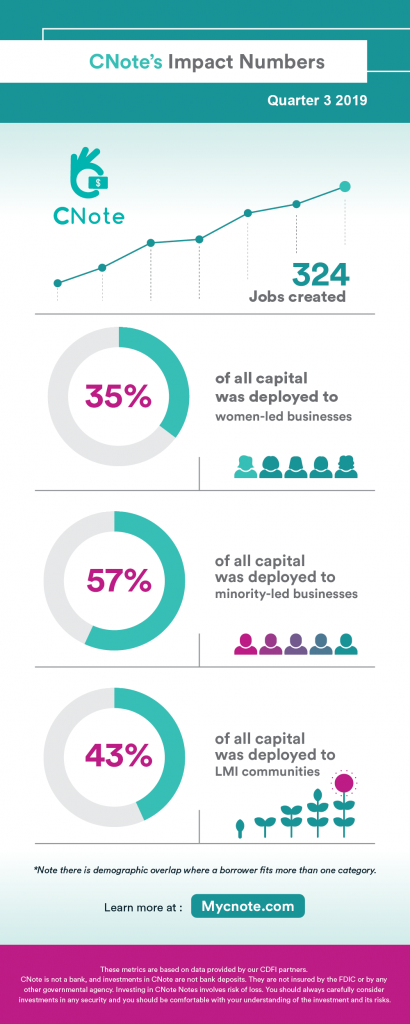
In Q3 2019, our members helped create/maintain 324 jobs!

Over half of all invested capital was deployed with minority-led businesses.

If you’d like to see our annual impact data, along with an explanation of how we map CNote’s impact investments to the UN’s Sustainable Development Goals, read our 2018 Impact Report.