Monthly Archives

February 2022

By Equality, Migration V2, Small Businesses

Investing In Black-owned Small Businesses To Close the Racial Wealth Gap

There is a staggering disparity between the wealth of Black communities and their white counterparts in the United States where wealth is the difference between financial and social mobility and terminal economic insecurity. In 2019, Black households, on average, had 14.5 percent of the wealth of the average white household. This disparity is reflected throughout racial inequities in financial access, educational attainment, and health outcomes for people of color.

Entrepreneurship and business ownership are crucial and proven ways to develop community wealth that benefits business owners and the people they employ. Black business owners have historically had unequal access to the benefits of business ownership and dealt with disproportionate barriers to accessing capital. Investing in the success of these enterprises owned and led by Black entrepreneurs is a critical component to closing the wealth gap and improving Black equity in America.

All of us can participate in supporting Black-owned small businesses. Here are a few ways to make a difference.
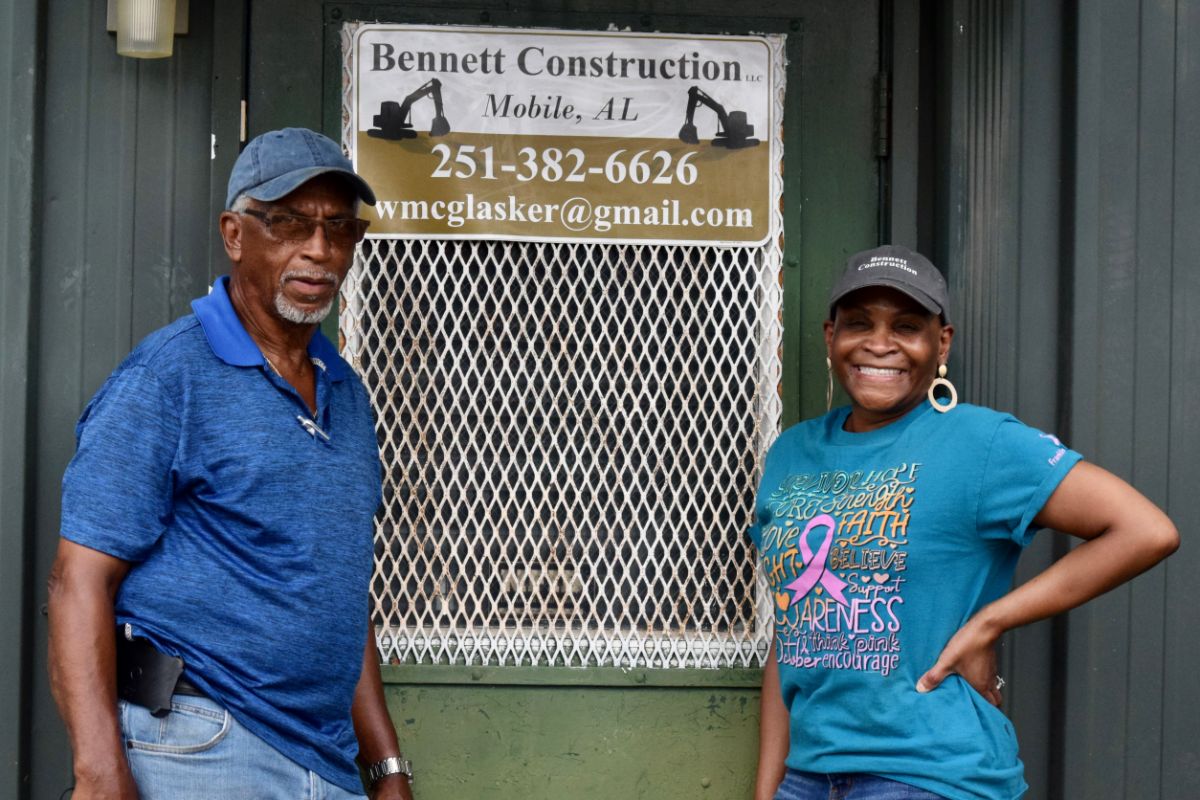
Ethel Brooks (right) is the cancer survivor and entrepreneur behind Bennett Construction

1. Shop and support Black-owned small businesses directly

In 2020 consumer spending accounted for 70% of economic growth. By taking the time to divert some of that purchasing power, buyers can contribute to strengthening Black businesses as a direct line to supporting Black communities and their economy with job growth and wealth generation. Black-owned businesses tend to be smaller, local establishments and multiple studies have shown that these small businesses reinvest in the local economy at a higher rate than chains do.

By shopping at Black-owned businesses, we can create more opportunities for meaningful savings, property ownership, credit building, and generational wealth. And luckily, this can be easy to do! Below we have compiled a list of resources to find Black-owned enterprises in your area.

  • Support Black Owned: This website and mobile app helps you find Black-owned businesses from all over the country.
  • African American Literature Book Club: This database is dedicated to the many Black-owned bookstores across America.
  • EatOkra: The EatOkra app is great for specifically finding Black-owned restaurants and food services.

The Tackett Firm is a Black woman-owned and led law firm that received a PPP loan to stay open during the pandemic

2. Encourage Your Company to Participate in Racial Justice Pledges 

In the aftermath of 2020’s racial justice protests, large corporations pledged billions of dollars to either support or directly spend money at Black-owned businesses.

​​Sephora, for example, announced last year that they will increase their shelf space for Black-owned businesses from 3% to 15% and Target pledged to increase the number of Black employees by 20%. Not only is there a strong business case for companies to follow through on these promises, but supporting Black-owned businesses has far-reaching positive implications for Black communities and the economy overall

You can advocate for greater diversity, equity, and inclusion within your own organization by pushing for similar commitments. Consider taking The 15 Percent Pledge, which is a call to action for major retailers and corporations to join their peers creating supportive ecosystems for Black-owned businesses to succeed. 

Otherwise, explore racial equity pledges that work for your firm. Check out Just Capital’s Corporate Racial Equity Tracker to get inspired by other corporations’ approaches to racial justice. 

Tanesha Sims-Summers is the female entrepreneur of color behind Naughty But Nice Kettle Corn Co.

3. Bank with Black-led Financial Institutions 

A 2017 study by the National Community Reinvestment Coalition found that traditional banks were twice as likely to provide business loans to white applicants than Black ones. This is reflected in the finding that 30 percent of black families are underserved by banks and 17 percent are disconnected from banking opportunities.

Intentional about helping the Black community, Black-led financial institutions tend to serve African Americans more than other banks do. Growing the deposit base for these organizations directly expands their capacity to increase financial access and wealth generation within the communities they serve.

Consider transitioning your banking relationships to include Black-owned or led financial institutions. Investopedia, Mighty Deposits, and Business Insider all offer comprehensive guides to Black-led financial institutions available by state, and equally share further background on the history and merits of Black banking. 

The Harlem Entrepreneurial Fund is one such Black-led financial institution.

4. Explore CNote’s Wisdom Fund

A report found that Black-owned businesses decreased by more than 40% in April 2020, which was more than other racial and ethnic groups. Today, the number of Black-owned businesses has since recovered, and currently, there are 30% more Black-owned businesses than there were pre-pandemic. Much of this growth is being driven by women of color

Historically women of color entrepreneurs have faced the compounded barriers of racist and sexist lending practices endemic to the financial system. Black women entrepreneurs have a median net worth 10 times greater than that of their nonbusiness-owning peers. Investing in the success of Women of Color entrepreneurs, therefore, has an outsized effect on the development of Black economies.

CNote launched the Wisdom Fund product to directly address the disparity in small business lending and further investigate the barriers to capital that burden Women of Color entrepreneurs. Capital invested in the Wisdom Fund is deployed with mission-driven lenders across the US as affordably-priced loan capital targeting female small business owners. 

You can learn more about the Wisdom Fund and the work we’re doing to dismantle capital barriers for Women of Color here or inquire about investing directly via support@mycnote.com.

Ebony Harris and her staff at In Good Hands Learning Center in Jackson, Tennessee

Supporting Black-owned businesses is a direct line to supporting Black communities and advancing racial equity. Above we’ve listed just a few avenues to explore, but the truth of it is today there is a myriad of options to authentically advance inclusive economies and shrink the persistent racial wealth gap year-round.

Learn More

  • CNote is a women-led investment platform that empowers individuals and institutions to invest locally to further economic equality, racial justice, gender equity, and address climate change.

By Borrower Stories, Community Partners, Migration V1

These Maine CDFIs Are Showing Mainstream Lenders How to Open Doors For Muslim Borrowers

When Yassin arrived in western Maine in 2008 as a refugee from Djibouti, he knew that he wanted to start his own business one day. In recent decades, Maine has become a destination for a growing population of immigrants like Yassin, who are seeking to build a life for themselves in the U.S. According to Yassin, however, new Mainers often find themselves in difficult living situations due to a shortage of quality affordable housing and other cultural and structural barriers. Therefore, although Yassin was trained as an accountant in Djibouti, his entrepreneurial spirit led him in a different direction.

Photo credit: The Genesis Fund/Flax Studios

To address the renter-rentee issues in his community, Yassin wanted to purchase apartment buildings and rent out units to immigrants who could relate to him. Despite his desire to start his own business, Yassin wasn’t able to go to a traditional lender to apply for a small business loan. That’s because many Muslim borrowers like Yassin are prohibited by their faith practice from paying or receiving interest. As Yassin discovered, most traditional lenders weren’t willing to modify their conventional lending practices or to consider non-interest-based lending models in order to accommodate aspiring Muslim entrepreneurs like him.

Photo credit: The Genesis Fund/Flax Studios

That’s when Yassin connected with Coastal Enterprises Inc. (CEI), a community development financial institution (CDFI) that’s been working in Maine since 1977 to build livelihoods, wealth, and a more equitable and sustainable economy. CEI received a grant to focus on immigrant and new-Mainer entrepreneurs who needed small business start-up funding but who weren’t able to access conventional lending. What the CEI team came up with was a fee-based lending program designed and developed with Maine’s Muslim community in mind.

Fee-based lending works like this: First, these loans are loaned out with a 0% interest rate. Second, the principal of the loan is divided into equal monthly segments depending on the loan terms (e.g. 84 segments for a seven-year business loan). Then, any fees associated with the loan (e.g. costs associated with closing and administering the loan) are calculated and transparently shared with the customer. Depending on the size and terms of the loan, a borrower can either prepay the fees upfront (i.e. pay a $750 fee on a five-year, $10,000 small business loan) or, in the case of larger loans (i.e. a $300,000 commercial real estate loan), the fees can be divided into flat, even monthly allocations that are added to the monthly principal payments.

John Egan and Yassin. Photo credit: The Genesis Fund/Flax Studios

John Egan worked at CEI for 20 years and is now the chief lending and program officer at the Genesis Fund, another Maine CDFI. He adapted the fee-based lending approach to the Genesis Fund’s work, which is centered around affordable housing and community facility finance, including multifamily and commercial mortgage offerings. Through this new loan product, the Genesis Fund has now provided loan capital to Yassin for three properties, which provide rental housing and space for childcare providers serving the immigrant community in Lewiston. According to John, one of the reasons why fee-based loans work is because they’re designed to make sense. “Folks that have a prohibition against paying interest because of their religious convictions do not have the same prohibition about understanding how business works,” he said. “The idea that a fee is attached to the activity of lending money at 0% is not a philosophical or religious conviction challenge, and from what we’ve found, everybody can get behind the concept.”

Photo credit: Soggy Dog Designs

John pointed out that, besides a small distinction in how promissory notes are written and how loans are packaged in the loan software, these fee-based loans “live, breathe, serve, and pay” in CDFIs’ portfolios the same way as interest-based loans. 

John said that when Genesis was crunching the numbers on fee-based loans, he and his colleagues determined that if the loan remains outstanding for seven to ten years, which is typical in Maine, their returns would be about the same as they would with an interest-based loan. “These aren’t a net deficit on our portfolio,” he said. “Instead, we saw that fee-based loans would allow us to actually deploy more capital, further our mission, and reach a group of people that have no access to the mainstream banking system. When we saw that, we were pretty quick to say ‘of course we’re going to do this.’”

‘That’s Part of Our Job as CDFIs’

To date, Genesis Fund has a handful of fee-based loans in its portfolio, and although John and his colleagues hope to increase that number by double digits in the next two years, he’s arguably more enthusiastic about getting local banks to adopt fee-based lending in the near term. According to him, that’s part of the innovative role of CDFIs: to find new ways to fill gaps in the lending market that can in turn be picked up by traditional sources of capital. “That’s part of our job as CDFIs,” John said. “It’s to demonstrate these community projects so that next time, they can be financed by banks, not by us.”

This isn’t the first time that Genesis has led by example in order to get traditional lenders to innovate. For example, Genesis currently has 10 resident-owned manufactured home parks in its portfolio. Although “that’s a drop in the bucket” for a local bank that might have thousands of loans in its portfolio, John says that being able to share data from even a small sample size helps to assuage the concerns of risk managers and risk-averse bankers. By demonstrating the sound economics of deploying loans to manufactured home parks, Genesis helped pave the way for three Maine community banks to participate in financing these resident-owned communities.

Importantly, John isn’t nervous about losing business to local banks; he’s more focused on ensuring that banks understand what CDFIs like Genesis are and aren’t doing, especially regarding fee-based lending. “We’re not a granting agency, and we’re not giving away money like a foundation,” he said. “We’re lending with sound finance principles. We proved the concept and demonstrated how to mitigate the risk, and now it’s time to get banks involved because their volume is so much bigger. We’re confident that we’ll be successful in doing that.”

Meanwhile, John and his colleagues at Genesis are exploring other innovative lending programs in their community, including advocating for a fee-based home mortgage product for immigrant families to buy their first home in Maine. John says that he’s working with state housing officials, local credit unions, and developers to make it happen; however, anecdotally speaking, he said that the first lender to come out with such a product “is going to get run over with applications.” That’s because there is so much demand from immigrants who want to put down roots in Maine. “It’s not a secret,” John said. “When somebody can own property in their neighborhood instead of rent, they have a much louder voice. When you’ve got a higher concentration of owner-occupants in a neighborhood, those people take pride in their properties and reinvest in those properties, and community conditions improve. That’s what Maine needs.”

Photo credit: The Genesis Fund/Flax Studios

In the meantime, small real estate investors like Yassin — entrepreneurs who’ve benefited from fee-based loans from CEI and the Genesis Fund — are stepping up to provide affordable and accessible housing for the immigrants in their community. Today, Yassin owns 12 properties, and he estimates that 90% of his residents are immigrants. According to him, without having the opportunity to simultaneously borrow money and adhere to his Islamic faith, he wouldn’t have been able to pursue his entrepreneurial dreams, including hiring two full-time employees. “Honestly, if that program wasn’t there, then I wouldn’t have my business,” Yassin said. “[Fee-based lending] opened up the life I have today.”

Learn More

  • The Genesis Fund provides innovative financing by soliciting investment loans from individuals, churches, corporations, and foundations, and then re-lending the money at favorable terms to nonprofit organizations developing affordable housing and community facilities for underserved people and communities throughout Maine and beyond.
  • CNote is a women-led investment platform that empowers individuals and institutions to invest locally to further economic equality, racial justice, gender equity, and address climate change.
By CNote, Community Partners, Migration V2

Free Resources for Growth in 2022

On January 26th, 2022 CNote hosted a webinar alongside Inclusiv and CUNA Strategic Services where they discussed key resources to help mission driven community financial institutions grow in 2022 and deepen their community impact.

Title:

Deepening Community Impact: A Discussion on Key Resources to Help Your Organization Grow in 2022

Brief Summary:

Credit unions and other mission driven depository organizations that focus on financial inclusion and community development outperform their peers. “Mission is now the opportunity for greater margin,” as Cathie Mahon of Inclusiv puts it. In this webinar, you will learn about the supports which exist to help credit unions and depository organizations transition to a financial inclusion mission and the benefits that kind of transition has on the growth of an organization. You will also learn about the importance of using data based measurement systems to capture the impact and mission fulfillment financial institutions achieve as a way to build the industry and reach new communities. Lastly you will learn about the visibility, partnership, and capital opportunities mission-driven organizations gain through capital intermediaries like CUNA, Inclusiv, and CNote.

Topics include:

  • How to access new sources of growth capital
  • How to tap into non-brokered, low-cost deposits
  • How to tell your story better to drive increased membership
  • How to access government programs that may support your growth or TA efforts

Speakers include:

  •  Mike Schenk, Deputy Chief Advocacy Officer for Policy Analysis and Chief Economist, CUNA
  •  Cathie Mahon, President, and CEO, Inclusiv
  •  Catherine Berman, Co-founder, and CEO, CNote