Monthly Archives

May 2019

By Equality, Impact Investing, Migration V2

What’s the Big Deal About Inequality And What Role Does the U.S. Federal Reserve Play?

Why Does Inequality Matter?

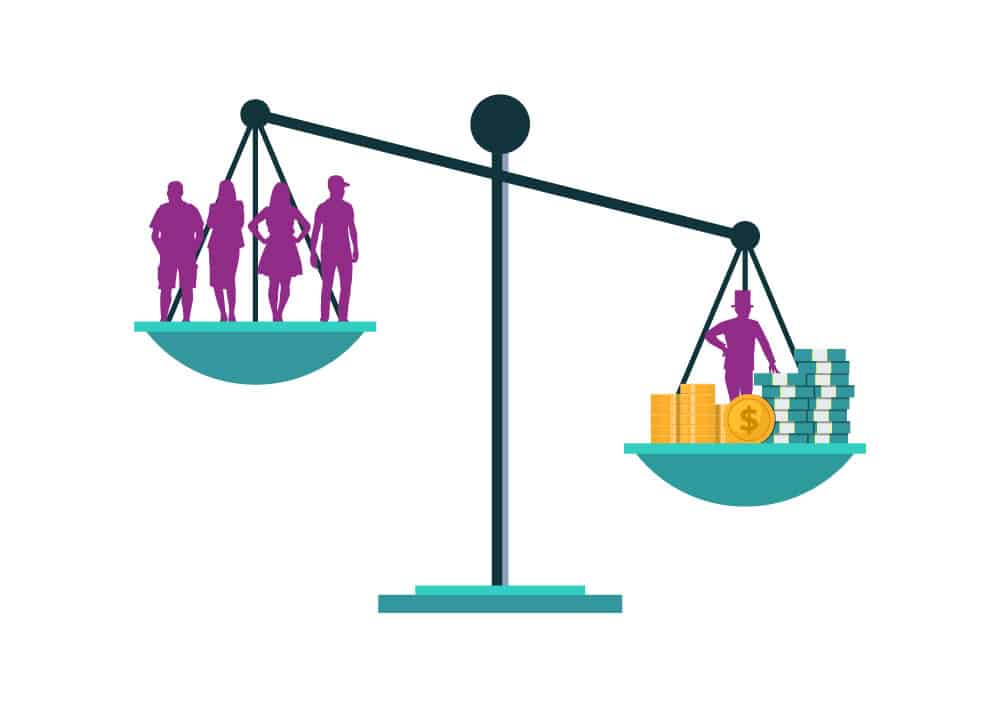
The phenomenon of increasing wealth inequality has emerged as one of the major socio-political issues of our time. Whether you turn to TV stations, newspapers, or internet blogs to keep up to date with news and current events, there’s a good chance that you have already seen the topic come up with increasing regularity.

Like other hot-button issues in contemporary political dialogue, arguments are raised regarding inequality’s root causes, the most effective policy prescriptions, and even whether it is even a problem in the first place.1 The fact that the wealth gap is indeed widening, however, is one rare point of general agreement, no matter one’s views on those other questions.

Take, for instance, the August 2017 New York Times piece by David Leonhardt titled “Our Broken Economy, in One Simple Chart.” Leonhardt leads with a chart depicting the differences in income growth between 1980 and 2014, broken down by income percentiles. While those in the lower percentiles once saw higher income growth than those in the top, the situation flipped by 2014 in dramatic fashion, resulting in the so-called “hockey stick” curve, where income growth only skyrockets well into the top decile, particularly at the 99th percentile. Additional charts throughout Leonhardt’s piece all indicate a shift in the distribution of income growth over the past several decades, ramping up significantly in the last few years.

Ray Dalio Enters the Fray

While TV pundits and newspaper columnists continued to argue over the seemingly widening inequality, a LinkedIn blog post penned by famed hedge fund manager Ray Dalio surfaced in April of this year and kicked off another explosion of press coverage.2 Dalio, the billionaire founder of Bridgewater Associates, the world’s largest hedge fund as measured by discretionary assets under management, uses the blog post to defend his thesis that “capitalism is now not working for the majority of Americans.”    

In the piece, Dalio acknowledges the productive power of capitalism, which he defines loosely as “the ability to make money, save it, and put it into capital.” At the same time, he believes capitalism has produced “self-reinforcing spirals” that in turn have created “widening income/wealth/opportunity gaps that pose existential threats to the United States.” By the end of Part 1, Dalio connects the phenomenon of widening inequality to the civil unrest and increasing ideological polarity that has led to the rise of populist political leaders worldwide as well as in the U.S.

Dalio engages with the ideas in his post from a systems engineering standpoint, placing emphasis on structural features of the economy. To that end, he slices and dices the data to produce graphs and statistics on such topics as income mobility, education, and health. While the structural reforms Dalio proposes are generally quite vague, he does more clearly spell out a series of investments he recommends focusing on. Areas that he believes have “great double bottom line investments for the country” include programs in early childhood education, microfinance, infrastructure, and public health.

Where the Fed Fits In

Although easy to miss amidst the many charts and statistical discussions of poor social outcomes and seldom discussed in mainstream media channels, Dalio regards the Federal Reserve as a key player in his “diagnosis of why capitalism is now not working well for the majority of people.”3 Recognizing that “reality works like a machine with cause/effect relationships,” Dalio states the following, emphasis added):

Central banks’ printing of money and buying of financial assets (which were necessary to deal with the 2008 debt crisis and to stimulate economic growth) drove up the prices of financial assets, which helped make people who own financial assets richer relative to those who don’t own them. When the Federal Reserve (and most other central banks) buys financial assets to put money in the economy in order to stimulate the economy, the sellers of those financial assets (who are rich enough to have financial assets) a) get richer because the financial asset prices rise and b) are more likely to buy financial assets than to buy goods and services, which makes the rich richer and flush with money and credit while the majority of people who are poor don’t get money and credit because they are less creditworthy.

Shortly thereafter, Dalio runs through a causal chain of events that he believes brought the United States economy to this point. Notably, central bank quantitative easing policy is the second entry on the list, preceding the widening inequality gap, rise of global and domestic populism, and social and military conflicts that Dalio fears will result. He largely repeats the same points as the quotation above when he states that the quantitative easing policies pursued by central banks following the debt crisis of 2008 “pushed asset prices up and pushed interest rates down,” which largely served to “benefit those with financial assets (i.e., the haves).”

Inequality and the Federal Reserve

That there is a causal relationship between central bank policy and the price of financial assets, is far from some esoteric economic theory. Even President Trump has implicitly recognized the connection between Federal Reserve policy and US stock market performance in the following tweet4:

In response to the general pressure exerted by the Trump administration, Federal Reserve Bank of Kansas City President Esther George was recently quoted saying, “Lower interest rates might fuel asset bubbles, create financial imbalances, and ultimately a recession.”5 Despite opposing President Trump’s wishes, Ms. George’s quote is perfectly consistent with the implications of his above tweet, as well as with Ray Dalio’s discussion of the consequences of central bank policy following the debt crisis of 2008.

Plenty of others are also taking notice of the apparent relationship between central bank policy and widening inequality. For instance, Twitter user Nid had this to say:6

Albert Gallo, a partner at Algebris Investments, corroborates Dalio’s central bank narrative, brief as it is, and places the brunt of the blame at the feet of central banks. In the April 26 Bloomberg article appropriately titled “Central Banks Have Broken Capitalism,” Gallo draws attention to the fact that central banks have injected “unprecedented amounts of cash into the global financial system” for a decade now, propelling stock market prices to record highs while also driving global debt to “more than three times world gross domestic product.” Meanwhile, sustained ultra-low interest rate policies have led to more leverage and risk in stock markets and increasing inequality by “giving large firms an advantage through cheap funding in bond markets.” In Gallo’s view, the unprecedented actions undertaken by central banks during the financial crisis of 2008 may have cushioned downturns until now, but only but in the process “have turned capitalism into a short-sighted game of kick-the-can.”

Meanwhile, over in the pages of the Economic Equality blog, Karen Petrou notes how prevailing economic orthodoxy assumes that extremely low interest rates promote equality by allowing more people to access debt. However, the ultra-wealthy have access to the best wealth managers and have a much better chance of beating zero or negative market returns. Low and middle-income households face a considerably more difficult situation, as quantitative easing has driven out asset classes that have traditionally provided lower but more stable returns. In addition, the connection between low interest rates and increased lending rates is also empirically dubious, as bank loans are less profitable as interest rates approach zero.7 In short, Fed policy has been great for hedge fund managers like Ray Dalio, but not for low-income households who have been largely frozen out of the loan market.

On Inflation

In his LinkedIn post, Dalio notes that real wages net inflation have not risen since the 1970s, It is curious, however, that he and many media pundits have quoted statistics to that effect without considering the other side of “real” economic variables.8 In short, changes in “real” variables over time can stem from movements in two different metrics, namely the nominal value of the variable in question and the rate of inflation. The stagnation of real wages, then, means that nominal wages have largely kept pace with inflation over the decades under observation.

To illustrate with a very simplified example, imagine that you earn $50,000 per year and the inflation rate during that time is 1%. If your salary remains the same at the start of the next year, your nominal income will still be $50,000, although your real income is now only $49,500. This is because goods and services cost 1% more than they did during the previous year, reducing your purchasing power to only 99% of what you enjoyed the year before. Of course, your salary may also rise to offset the inflation, as would be the case if you now earned $50,500. In this example with a 1% inflation rate and $50,000 base salary, it would take a pay raise greater than $500 per year to see an increase in real income.

Michael Lebowitz draws attention to the pernicious inequality-generating effects of inflation in his article “Two Percent for the One Percent.” Lebowitz draws attention to the disparate effects of the Federal Reserve’s targeted 2% annual inflation on those living paycheck-to-paycheck versus those with a portion of their wealth in financial assets.9 While those who consume most of their income and consequently invest very little struggle to maintain their standard of living, the wealthy are in a much better position to take advantage of investment products that can keep pace with inflation and benefit from financial leveraged that low interest rates make more accessible. Lebowitz concludes by pointing out how steady inflation “drives a negative feedback loop,” as those who suffer most under the inflation face an incentive to consume more in the present in expectation of future inflation.

The Cantillon Effect

Inflation can thus be considered a “silent tax” that decreases the purchasing power of wealth held in cash.10 Meanwhile, there is an additional aspect of inflation that further benefits the well-connected while leaving lower-income households to deal with the adverse consequences. To use economics jargon, money is not truly “neutral,” meaning that new injections of money into the economy do not lead to higher prices all at once. Instead, different sectors of the economy adjust to the increased money supply at different times.

This piece published by the Foundation for Economic Education explains the mechanisms of what is now referred to as the “Cantillon Effect,” named after 18th-century French economist Richard Cantillon. Cantillon posited that those who first receive newly created money can enjoy purchasing goods and services at old prices before adjustment has taken place resulting from the increase in the money supply. Instead, prices adjust gradually as the new money filters throughout the economy. In the end, those who are furthest removed from the source of the money creation are most negatively impacted by inflation, as they faced higher prices before a commensurate rise in nominal money.

So what does this mean in our economy today?

When the Federal Reserve announces any form of quantitative easing, investors expect prices to rise and seek to enter financial markets, bidding up the prices of these financial assets. Companies and individuals already holding financial assets enjoy this windfall and can in turn invest and consume at old prices using the new profits. Gradually, the new money travels through the economy, bidding up the costs of resources until prices have adjusted to the new supply of money. Wage earners face higher living costs before their incomes can rise commensurately and must demand raises over time to maintain their old purchasing power. While inflation does not affect real economic factors, in the long run, it does affect how resource prices adjust in the short run and serves to aggravate the phenomenon of widening wealth inequality.

Final Thoughts

As Ray Dalio warns in his LinkedIn post, a failure to understand why income inequality is becoming more extreme and how to change the situation could result in “a great conflict and some form of revolution that will hurt most everyone and shrink the pie.” Yet, it is still rare to hear mention of how central bank policies benefit the wealthy and well-connected while comparatively damaging the purchasing power of low-wage workers and households that rely upon savings rather than financial markets.

At CNote, we are committed to growing the pie of wealth by providing those otherwise excluded from the banking system the access to capital they need to pursue their entrepreneurial dreams and build businesses that increase prosperity for all. By investing with CNote, you can earn an annual return of 2.00%, more than keeping pace with the Federal Reserve’s stated inflation target, while making a real impact in the lives of many in underserved communities.

We hope you will consider joining us in our mission to give those struggling in our economy the tools they need to build a better life for themselves, their families, and their communities. Changing macroeconomic policy may seem too daunting, but that doesn’t mean we cannot drive change at a micro level.

By Borrower Stories, Migration V2

Meet Dr. Jeremy Busch, Navy Veteran, Podiatrist, and CDC Loan Recipient

Growing up, Jeremy Busch never thought about becoming a podiatrist. According to him, it was the last thing on his list. The sight of blood — in real life, in movies, or on television — made him squeamish, and besides, his passion was engineering, not healthcare.

Then September 11th happened.

In 2001, Busch was a cadet at the United States Merchant Marine Academy, just across the Long Island Sound from Ground Zero. The campus quickly became an aid station, and facilities were used to both help victims and store bodies. Lacking any kind of medical training, Busch felt helpless. As some of his peers sailed towards the fallen buildings, Busch stayed behind to set up cots and to prepare food at the academy. “I felt like there was more I could be doing to help people,” Busch said.

“I felt like there was more I could be doing to help people.”

Busch changed career paths. He signed up for an EMT course and began volunteering at a local hospital. It was too late for him to switch majors, but while he was completing his engineering coursework, he enrolled in pre-med classes. In 2005, when he graduated from the academy, he was accepted into a condensed post-baccalaureate program for medical prerequisites at the University of Pennsylvania, and in 2008, he matriculated at The Lewis Katz School of Medicine at Temple University.

While he was pursuing his medical degree, Busch remained in the Individual Ready Reserves, having already spent time as a midshipman supporting the war effort in both Iraqi Freedom and Enduring Freedom. After eight years of service with the U.S. Navy, he received an honorable discharge as a lieutenant. Even though the veteran didn’t initially know where he wanted to go in the medical field, Busch knew he wanted to have his own practice. “I had no interest in working for a hospital,” he said, “and I didn’t have any interest in working for another doctor except for obtaining the knowledge that I would need to utilize in order to start my own practice.”

In 2012, Busch became a Doctor of Podiatric Medicine and moved to Long Beach, California for his residency requirements, where he continued to seek out opportunities to prepare himself to one day build a successful practice.

Rescuing a Sinking Ship

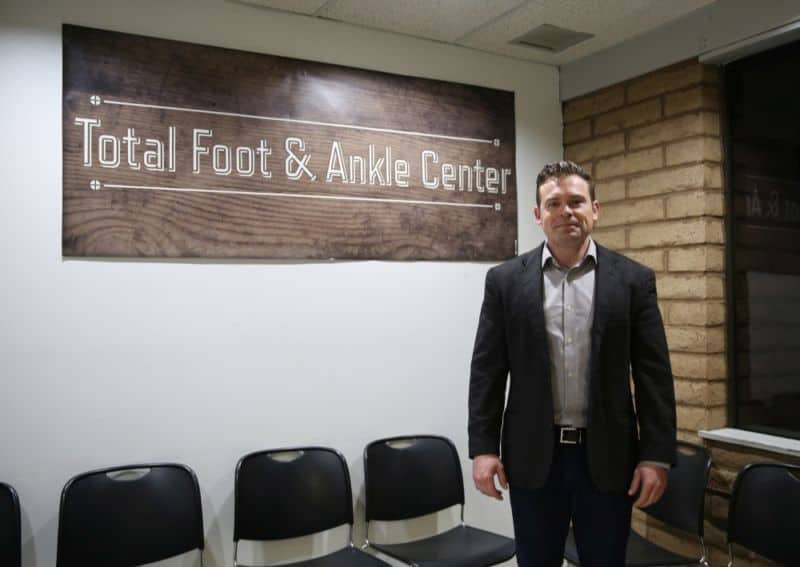
After completing his residency, Busch got a shot at his dream: his own practice. However, taking over Total Foot & Ankle Center in Riverside, California wasn’t easy. The practice he was inheriting was an antiquated operation that needed massive TLC. By the time Busch took it over in late January of 2017, he had his work cut out for him. He was commuting an hour and a half each way and seeing between 40 to 50 patients every day.

“I had to learn how to see a ridiculous number of patients without losing the quality of care,” Busch said. “As doctors, we’re forced to see so many patients in order to be profitable. It’s sad, but it’s true. You can do it, it’s just not a skill that comes easily.”

While Busch was fine-tuning his skills as a patient-focused podiatrist, he was struggling as a business owner. “I didn’t know anything about business,” he said. “It was completely insane, the mountains of paperwork taking over a practice. There was no way of staying on top of everything. I was going to bed at midnight and waking up every single day having to run this marathon.”

Fortunately, Busch found CDC Small Business Finance, a nonprofit that partners with CNote to offer small business loan options to entrepreneurs in California, Arizona and Nevada. If it wasn’t for Busch’s CDC loan officer, Anna Marie Cruz, the former midshipman wouldn’t have been able to keep the practice afloat. According to him, he was doing everything humanly possible to ensure the survival of his practice and to meet payroll. “The CDC loan came through at a clutch time,” Busch said. “What CDC provided me was an avenue for obtaining a goal. They didn’t just throw a book at me say ‘go do it.’ They streamlined the process and answered my questions.”

“Podiatry is one of the medical practices where you can do things that have an immediate effect on people. It’s instant gratification. As long as I’m able to provide that high level of care, I’m going to expand as much as possible.”

The capital working loan from CDC gave Busch the financial runway he needed to get his feet underneath him as a business owner and to continue operations at Total Foot & Ankle Center. The capital injection helped him meet payroll, make minor improvements to the practice, and begin to scale. “It wouldn’t have been possible without that loan,” Busch said. “In the medical field, when it comes to insurance companies, it can take up to four months to get paid for services rendered. That’s frustrating, and it can be killer for sole private practitioners. Without that loan, I would have landed flat on my face.”

Stormy Clouds Behind, Calm Seas Ahead

Busch, however, didn’t land on his face. With the CDC’s help, he navigated a particularly challenging first six months. According to him, his best day as a business owner was when he was able to pay his ten employees with revenue dollars instead of loan money. “To turn around and pay my employees with a check that said ‘Total Foot & Ankle Center,’ it finally allowed me to breathe and say ‘it’s finally working,’” Busch said. “It gave me a lot of confidence.”

He’s quick to credit CDC — and his loan officer — for providing capital and business plan guidance that have ultimately kept the lights on at Total Foot & Ankle Center; however, Busch says without his upbeat, committed staff, his practice would be short on patients. “I can’t take too much credit,” Busch laughed. “My office manager hired such quality employees who turn these laborious appointments for patients into really warm and comforting interactions. My employees have the right attitude, and they make patients feel cared for.”

The word has spread: Busch says that between referrals from current patients and primary care doctors in the community, business is booming. “That’s one of the most rewarding and gratifying feelings,” he said. “I never had to go out there and promote myself.”

Today, Busch is looking to ride his early, albeit hard-fought success towards scaling his practice. He’s already opened a second office in Victorville, and he’s starting up a third location in Barstow. His goal is to ultimately grow Total Foot & Ankle Center and onboard another podiatrist who shares his values for helping people.

“That’s why I got into this,” Busch said. “Podiatry is one of the medical practices where you can do things that have an immediate effect on people. It’s instant gratification. As long as I’m able to provide that high level of care, I’m going to expand as much as possible.”

Learn More

  • Total Foot & Ankle Center
  • CDC Small Business Finance is a leading U.S. small business lender focused on helping entrepreneurs in underserved markets obtain financing.
  • CNote – Interested in helping create another story like Dr. Busch’s? CNote makes it easy to invest in great CDFIs like CDC, helping you earn more while having a positive impact on businesses and communities across America.
By Impact Investing, Migration V1

Retail Impact Investing Options

What impact investing options are currently available to retail investors?

What is impact investing and how can I participate? These are questions we often hear from individual investors looking to connect their money with meaning.


According to the Global Impact Investing Networking (GIIN), impact investing refers to investments that  are “…made into companies, organizations, and funds with the intention to generate social and environmental impact alongside a financial return.” The term was first coined in 2007 at the Rockefeller Foundation’s Bellagio Center, in recognition of the rapid growth of impact investing among retail investors over the years-to-come.
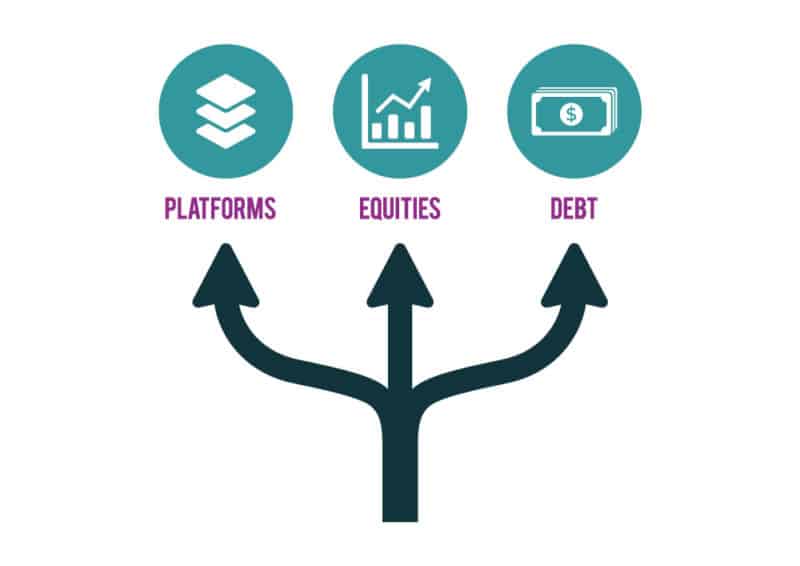
Given that there is a growing demand for readily accessible impact investment options, we’ve decided to compile a list of these that are available to regular investors. We’ll work to regularly update this compilation to cover the most popular and accessible options.

Although some of these companies could be classified as “competitors” of CNote, we are avid supporters of the impact investing movement. We believe that every new dollar committed to companies focused on moving impact investing forward is a win for both CNote and society-at-large. To that end, we hope you will find this guide helpful.

Methodology and Definitions

Since impact investing is a relatively new concept for most, the standards for what is and is not an impact investment can vary. We have compiled a list of companies that we feel have been generally accepted as offering impact investment products that are accessible to investors of all sizes. We believe that these companies fairly represent the current landscape of established retail offerings accessible to investors of any net worth. As a result, products and opportunities that may only be available to foundations, trusts, and high-net-worth investors did not make our list.

We recognize that some equity-focused platforms focus on divestment, wherein companies that do not align with a specific impact approach are excluded from their portfolio of investments.  Classic examples include companies that produce weapons, tobacco, and other so-called “sin” stocks. While we acknowledge this kind of socially-conscious investing, we are excited to see many platforms taking a more active approach by allocating capital directly to companies driving a beneficial social impact. After all, we believe impact investing can be so much more than a decision not to invest in a certain class of companies.

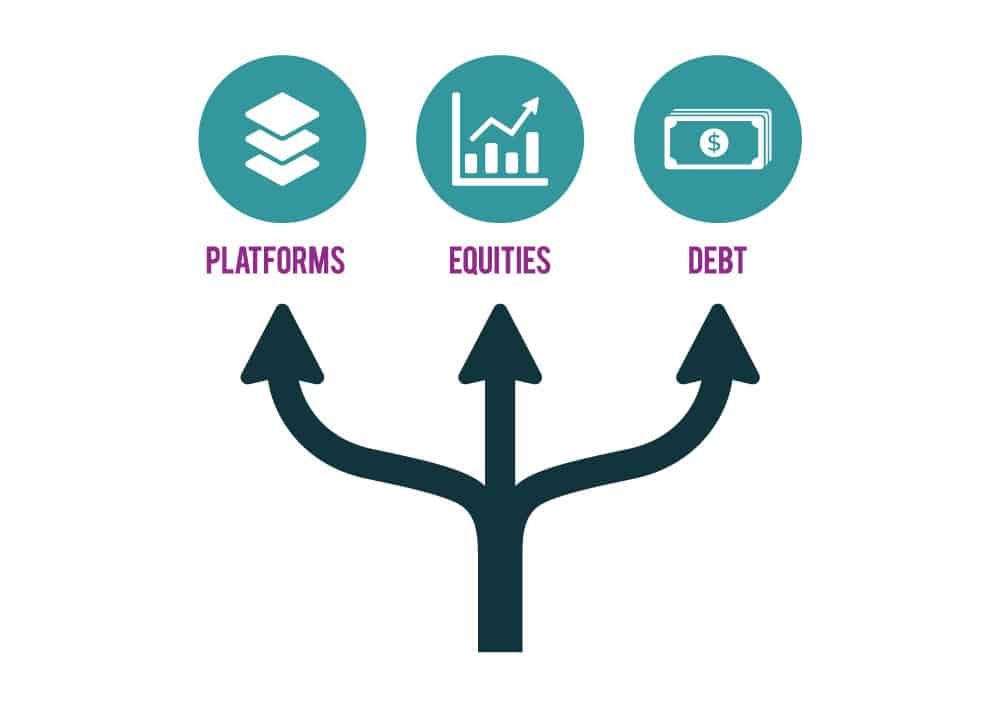
For simplicity, we’ve also tried to separate impact investing options into various categories: robo-advisors, fixed income investments, exchange-traded funds (ETFs) and other offerings. Some of these offerings have their own platforms where you can invest directly, like CNote, whilst others are available through brokers, or via direct offerings like Calvert.


Impact Investing Options
 

Aspiration

Category: Robo-advisor

Doing business in an industry that has traditionally served the wealthiest, Aspiration has made it their mission to “bring the best financial solutions services to everyone.” Aspiration offers a mix of banking and retirement services, links to charitable giving and investment products.

Unlike other platforms, Aspiration allows customers to decide how much to pay towards their monthly fee, “what you think is fair – even if it is zero.” They also incorporate the Aspiration Impact Measurement (AIM) system into their banking which allows you to track your personal ‘People and Planet’ impact as you shop.

  • Minimums: $0- 10
  • Fee Types: “Pay What is Fair”
  • Products: Banking Services, Retirement Services, Professionally Managed Funds
  • Returns: Market

Summary: Aspiration largely falls in line with other impact investment options like Swell or OpenInvest. They see themselves as being “radically accessible” and serve a relatively young consumer base. Such accessibility is apparent in the variety of banking services they offer in addition to a dedicated fund.

However, the products they offer, while wide ranging, are ultimately limited. For example, they only offer the option of two investment funds, with only one, their “Redwood Fund,” impact-focused. They do however offer seven charitable causes one can donate to for a tax deduction, but these are not investment products.

Conclusion: Aspiration is a platform that caters to those seeking accessibility and those new to impact investing who may be intimidated by traditional financial products or turned-off by the modus operandi of most large financial institutions. One of Aspiration’s main selling points is their “pay what is fair” fee structure. This flexible fee structure and lack of minimum investment makes it a good option for a potential investor simply looking to get a feel for the investment landscape.
 

Betterment

Category: Robo-advisor

Betterment, an investment platform founded in 2008, has recently added elements of impact investing to their lineup of products. In 2017 they introduced their “Betterment SRI” (Socially Responsible Investing) portfolio strategy. They seek to blend their SRI approach with the features of their general investing strategy, stating, “We allow socially conscious investors to express that preference in their portfolios without sacrificing the aspects of Betterment’s advice that protect their returns the most: proper diversification, tax optimization, and cost control.”

  • Minimum: $0 for their Digital Plan; $100 000 for their Premium Plan
  • Fee Types: 0.25% for Digital; 0.4% for Premium
  • Products: US Large- Capitalization Stock
  • Returns: Market

Summary: Betterment offers tax-loss harvesting and great account minimums, catering to millennials and those with an eye towards retirement. Betterments is still attempting to cohesively integrate their main investment platform with their impact investment platform. One of the main limits to their approach is that, “The ESG scoring approach to SRI does not fully eliminate companies that investors interested in SRI may consider undesirable.”

As an example they do not exclude ETFs, SUSA and DSI, whose stock offerings include investments in, “some energy companies that engage in oil and natural gas exploration, like Hess.” Betterment is not alone in this as most successful ESG investment methods often target large ETFs. Positively, Betterment is honest about its shortcomings, and  its options are still relatively conservative.

Conclusion: Betterment is a serviceable investment platform, offering low minimums, great value for retirement accounts, and clear utility for people without a large disposable income. As an impact investment platform, they have an approach that is safe but relatively unambitious.
 

Capital Impact Partners

Category: CDFI

Capital Impact Partners is a nonprofit CDFI that seeks to leverage its thirty-plus year relationship with traditional financial institutions and other funding sources to support the equitable development of local communities. They achieve this by arranging loans tailored to the needs of their low and middle-income borrowers.

Capital Impact Partners is focused on services like; healthcare, education, affordable housing, and healthy foods for those in underserved communities. Their operating vision is to help create, “a nation of communities of opportunity built on a foundation of equity, inclusiveness, and cooperation.”

  • Minimum: $1000
  • Fee Types: None
  • Products: Fixed Income Notes
  • Returns: Fixed Interest Rates according to 1 to 10-year terms

Summary: Capital Impact Partners maintains an on-balance sheet loan portfolio of $311.3 million, over a third of which has been allocated towards education. From there, housing, healthcare, and community development round out their portfolio. They tout that they have served over five million people and have created more than 37,000 jobs.

Those interested in investing through Capital Impact Partners must purchase “Capital Impact Investment Notes” through their brokerage account. This makes the process simple but limits your ability to have any real say in where your money will go. Therefore, investing in Capital Impact Investment Notes for social impact purposes requires that you largely agree with their core values and trust that your money is being put towards a meaningful cause.

Conclusion: Capital Impact Partners maintains a relatively strong AA- S&P credit rating. Coupled with their thirty-five years of business, this makes them a serviceable investment vehicle for those who share the same impact investing priorities and wish to direct funds towards the development of underserved communities.

 

CNote

Category: Platform & CDFI

CNote is an award-winning, first-of-its-kind financial platform that allows anyone to make money investing in causes and communities they care about. With the mission of closing the wealth gap, CNote directs every dollar invested toward funding female- and minority-led small businesses, affordable housing and economic development in financially underserved communities across America.

  • Minimum: $1
  • Fee Types: No fees for retail investors. Other services like underwriting, customized investments, and specialized impact reporting for institutional investors likely have fees. 
  • Products: Fixed Income Investments
  • Returns: 2.00% product with quarterly liquidity

Summary: CNote seeks to fulfill its mission of closing the wealth gap, “by providing a new and sustainable capital source for our community-lender partners, generating better returns for our members, and by increasing capital access and economic activity in communities that need it most.”  

CNote is a strong option for investors who want to support community development across America and see the tangible impact their money is having. CNote produces regular borrower stories and impact metrics to highlight just how investors dollars are driving change.

CNote supports a variety of account types and customers including personal, trust and business accounts. Additionally, CNote provides robust support for financial advisors who want to invest and manage their clients’ funds. Finally, CNote supports institutional investors and works with foundations, large banks, and other traditional financial institutions to deliver impact at scale.

CNote has no minimums or fees.

Conclusion: If you want your money to make a tangible impact on individuals and communities across America, CNote provides competitive returns and flexible liquidity. 

 

Calvert

Category: Community Investment Note

Calvert was one of the first family foundations to trade mutual funds to avoid doing business during apartheid South Africa. They officially launched their portfolio and Community Investment Note in 1995. In their own words, Calvert has made it their goal, “to serve sectors and regions that are often overlooked or underserved by the traditional capital markets.”  

  • Minimums: $20 for direct and Online Plan; $1000 for Brokerage Account
  • Fee Types: Brokering fee for the Brokerage Account
  • Products: Fixed Income Investments
  • Returns: Market

Summary:  Calvert has a separate mutual fund and foundation.  Their foundation offers three main loan products; balance sheet loans, structured debt loans, and asset-backed facilities.

The non-profit places special emphasis on nine social impact sectors, “shaped and ever-evolving by a maturing impact investing industry and macroeconomic shifts that affect these markets.” Those impact sectors include; Affordable Housing, Community Development, Education, Environmental Sustainability, Health, Microfinance, Renewable Energy, Small Business, and Sustainable Agriculture. Calvert has a strong industry reputation, boasting a note balance of $390,870,019. They offer a return on investment in the range of 0-4%.

Conclusion: Due to its long history, Calvert has earned its place as a trusted impact investment platform. The vast majority of their loans are funded through a combination of balance sheet and structured debt loans. Overall, Calvert offers both lower and higher cost options for potential investors.

 

Earthfolio

Category: Robo-advisor  

Earthfolio does not only bear the distinction of being the first online investment service to focus primarily on sustainable investing, but in 2015 they also launched their app. Earthfolio screens its investments against 10 ESG criteria. These stated ESG criteria include; Environment, Animal Welfare, Equality and Diversity, Non-Violence, Healthy Living, Corporate Governance, and Community Development.

  • Minimums: $25 000
  • Fee Types: 0.5% annual fee
  • Product: ETFs, Stocks, Bonds, Mutual Funds
  • Returns: Market

Summary: “Sustainability is not a niche for us,” Earthfolio states on their site, “it’s the DNA of how we’ve invested for over fifteen years. Every portfolio we build invests exclusively in a broad spectrum of sustainable mutual funds that screen on up to ten environmental, social, and governance, criteria.”

Earthfolio is a good choice for those looking for a more established platform, given that it is one of the oldest options on this list. Earthfolio caters to customers with $25,000 or more available to invest in any of their range of product offerings. Given this high minimum, Earthfolio may seem out of reach for young people looking to make an impact investment.

Conclusion: For an investor that has $25,000 or more to get started and wants a platform with a long track-record, Earthfolio offers a good set of products that is likely to fit most investors’ needs.
 

Hedgable

Category: Robo-advisor 

Hedgeable is similar to the other relatively new impact investment platforms on the list. Their mission, “to democratize the market!” seems to be exemplified by their very low minimums and the unique range of SRI themes they offer. Hedgeable focuses on eight different themes for its SRI platform; U.S. Social Responsibility, International Social Responsibility, LGBTQ Equality, Low Carbon Footprint, Alternative Energy, Female Leadership, Social Fixed Income, and Water Purification and Conservation.

  • Minimums: $1
  • Fee Types: 0.3%- 0.75%
  • Products: ETF, Mutual Funds, Equities, Commodities, etc
  • Returns: Market

Summary: With the motto “Private Wealth for Everyone,” Hedgeable offers a $1 minimum for opening an account and a range of personal, retirement, and corporate accounts. To fulfill their mission statement, Hedgeable allows individuals access to portfolios with, “customized asset allocation that can include access to asset classes typically reserved for only the wealthiest investors.”

Hedgeable is considered one of the better robo-advisors in the market right now because of the services and options it provides, according to Business Insider, but Hedgeable is not great for those starting out. As Conroy demonstrates in magnifymoney.com, those with accounts under fifty thousand dollars will be charged a 0.75% fee, while those with assets under management between one to ten million dollars face a 0.3% fee.

Conclusion: Hedgeable has a lot to offer as an impact investment platform. However, if you are a potential investor just getting started, there are other platforms out there that do not charge these fees. If you are an investor with a relatively large account, Hedgeable caters to you.

 

iShares

Category: Sustainable Investment Funds – ETFs

Summary: iShares is a family of exchange-traded funds managed by BlackRock. As implied by Larry Fink’s Letter to CEOs, BlackRock’s iShares platform has increasingly been placing an emphasis on its more sustainable investment offerings. The firm breaks down sustainable investing into four key categories: ESG investing, Thematic Investing, Impact Investing, and Screened Investing. iShares offers separate ETFs for each category.

Rates will vary across investment offerings and level of management.

Note: To invest in ETFs issued by iShares, you’ll need to have a brokerage account that allows you to buy and sell public equities and ETFs. There may be fees and other transaction costs associated with individual brokerage accounts.

You can learn more about iShares suite of SRI product offerings here on their website. Currently, they have around 14 unique offerings.

Motif

Category: Robo-advisor

Motif is a thematic investing app, meaning that they have compiled a group of stocks related based on a theme that one can invest in, as opposed to allowing investors to select individual companies or stocks. Describing thematic investing in their own words, Motif states, “We analyze data to uncover important trends driving the economy. Then we create dynamic portfolios of companies with exposure to these trends so that you can easily invest in them.” The three main investment themes in which Motif places primary focus are; Fair Labor, Sustainable Planet, and Good Corporate Behavior.

  • Minimum: Depends on the package/service you choose
  • Fee Types: None for Next Wave Portfolio; 0.25% annual fee for Motif Impact Portfolios; 0.5% annual fee for Motif Thematic Portfolios
  • Products: Stocks, ETFs, etc
  • Returns: Market

Summary: They define Motif as a, “basket of up to 30 stocks or ETFs intelligently weighted to reflect an investment theme, market insight or innovative trend.” One problem that some investors may have with Motif is the fact that dividends are not automatically reinvested. This slows down the investing process and, since it usually costs $4.95 per trade, makes the overall investing experience more expensive. Their management fee is also a cause of concern, as it is just an approximation and not the sum total of what it costs to do business with them.

Conclusion: Motif sells the idea of thematic investing because it is more comprehensive for investors who want to invest in causes rather than in single stocks. Motif has the issue of not reinvesting dividends automatically, which makes reinvesting feel cumbersome. With that said, it still gives investors the opportunity to make long term investments for issues they want to see change or transform with their investment.

 

Newday

Category: Robo-advisor

Newday, launched mid 2018, is a financial technology and institutional asset management company with the mission to, “spread the power of investing with your conscience”. Their portfolio is a “custom-made, proprietary, and targeted investment strategy” where customers can benefit their choice of 6 impact areas; Gender Equality, Fresh Water, Ocean Health, Global Impact, Climate Action and Animal Welfare. Investment is possible through their mobile app. 

  • Minimums: $5 
  • Fee Types: 1% annual fee
  • Products: Stocks, Custom Portfolios
  • Returns: Market 

Summary: Newday’s target demographic appears to be millennials as investment is strictly available via their mobile apps for IOS and Android phones, with plans to introduce a web-based platform in the near future. Customers can choose their impact, risk level and schedule recurring investments, via the app. They focus heavily on financial education with the “Learn” tab on their webpage as a key focus, regularly spotlighting companies they invest in and explaining their reasoning for said investment. 

They currently offer six equity portfolios consisting of approximately 20 to 40 individual stocks, with the aim of also introducing socially responsible checking and savings accounts later this year. All of their portfolios, except Animal Welfare, were built to reflect the 17 United Nations Sustainable Development Goals. Newday also donates 5% of their revenue from asset management fees to their NGO partners who include; Conservation International, Lonely Whale Foundation, Global Fund for Women and Water.Org. 

Conclusion: A Robo-advisor for millennials new to impact investing who want to learn as well as invest. The Newday platform is easy to use, transparent and affordable, allowing users to personally tailor their account according to their investment preferences and recommendations from Newday. However, Newday is still in its infancy with just over $1 million under management and is by no means a tried and tested method of investment.

 

OpenInvest

Category: Robo-advisor

Created in 2015, OpenInvest has a mixed approach, allowing you to compile a portfolio based on 12 different issue options. Of these, six are divestment strategies and six are investment strategies. Openinvest states that it is, “dedicated to using technology to bring honesty and transparency to financial services, while making socially responsible investing easy and more accessible.”

  • Minimums: $100
  • Fee Types: 0.5% annual fee
  • Product: Equities, some ETFs, Bonds, Mutual Funds, Custom Portfolios
  • Returns: Market

Summary: While OpenInvest offers a similar package to other new impact investment platforms on the market with regard to price, they, on the whole, take stronger political and moral stances than the other platforms on this list. They strongly value a commitment to the political stances they take and have admitted to, “frequently turning away customers who are not ready to invest or whose needs are met elsewhere.” They offer a new technology that allows members to proxy vote via their app, which may be appealing to some investors.

If your political beliefs align with OpenInvest, then you will probably love the platform. If they don’t, however, you might want to look elsewhere. They’ve recently received venture funding from a large group of respected investors, which may mean they’ll expand their product offerings in the near future.

Conclusion: For an impact investor who truly identifies with their message and political stances, OpenInvest is a good option. If you want to ease your entry into impact investing, there are other options that don’t require such a minimum investment or the support of their strong political positions.
 

Personal Capital

Category: Robo-advisor, Account Aggregator 

Personal Capital is a personal wealth management system that is focused on making investing simple even for a wide range of investor risk profiles. Within its portfolio of services, Socially Responsible Investing (SRI) is a key part of the firm’s offerings. By partnering with Sustainalytics, a global leader in ESG research and ratings, Personal Capital is able to help users curate stock portfolios that meet their individual impact preferences. 

Summary: Personal Capital encourages companies to connect all their financial accounts to get a “complete financial picture.” They then encourage customers to connect with an in-house financial advisor to create a retirement plan. Taking a hybrid approach, Personal Capital claims to “combine award-winning technology and financial tools with experienced people to create the smart, easy way to transform your financial future.”

Fee structures as of November 2019 are:

  • First $1 million: 0.89%
  • First $3 million: 0.79%
  • Next $2 million: 0.69%
  • Next $5 million: 0.59%
  • Over $10 million: 0.49%

Conclusion: If you’re looking to streamline the management of your finances and want help from a professional advisor managing your money Personal Capital may provide the right mix of human and technological touches. Their fees are competitive and they offer a suite of free tools to help educate and convert clients.

 

RSF Social Finance

Category: Social Investment & Donor Advised Funds

RSF Social Finance offers a diverse range of funds and makes a point to promote transparency as a key feature of their investment model, “We believe that inquiry and dialogue are essential to transforming people’s relationship with money and moving the economy toward greater equity.” RSF Social Finance organizes quarterly “community price gatherings,” where investors and borrowers have a chance to meet and where quarterly interest rates are decided, in addition to “Shared Gifting Circles,” which “give participants distribution and allocation authority over grant funds.”

  • Minimums: $1000 for Social Investment Fund; $100 000 for Regenerative Economy and Food System Transformation Funds
  • Fee Types: N/A for Social Investment Fund; 0.6% annualized Investment Fee in addition to a 0.75% – 1.25% annualized “Community Contribution” for Donor Advised Funds
  • Product: Various Specialty Funds
  • Returns: 1.25% (decided quarterly) for the Social Investment Fund; 1% annualized for the Regenerative Economy and Food System Transformation Funds

Summary: RSF Social Finance offers various fund options. The Social Investment Fund provides direct investment into social enterprises in the fields of climate & the environment, education & the arts, and food & agriculture. Meanwhile, the assets held in the Donor Advised Funds are kept in a, “mission-aligned investment portfolio, which seeks safe and liquid cash opportunities that achieve deep impact.”

RSF Social Finance have claimed a 100% repayment rate of principal plus interest to investors in every year since its 1984 inception. With that said, the 1.25% return for the Social Investment Fund has only begun for the 2019 calendar year, previously hovering between 0.75% to 1.00%. The relatively high minimums for the funds are offset by minimum-free gifting options like Money to Transform, Shared Gifting and their Seed Fund.

Conclusion:  Their giving options are all designed to give individuals who believe in the same mission the chance to put their own money towards the value-driven organizations and entrepreneurs identified by RSF. Overall, their diverse product offering, long track-record, and above-average transparency makes it a worthy option on this list.

 

Stash

Category: Robo-advisor

Stash explains that their core mission is making financial opportunity and literacy available to everyone. Their focus is on making investing as simple as possible, with younger investors serving as their target clientele. They encourage their users to, “Think big, start small” and offer custodial investment accounts for those under 18 years of age. The main investment themes on their platform are; Clean Energy, Reduction of Carbon Footprint, LGBTQ Rights, Gender Equality, Water Conservation, and other ESG focused companies.

  • Minimum: $5 upfront for Investment Account; $15 minimum for Retirement Account
  • Fee Types: $1 per month for under $5000, 0.25% fee annually for over $5000 for Investment Account; $2 per month fee for Retirement Account
  • Products: ETFs, Bonds, Commodities, Banking, etc
  • Returns: Market

Summary: Stash offers packages like “The Activist” or “The Techie.” It is similar to peers in the space, offering a variety of ways to make investing, especially with regard to SRIs, accessible. They are a thematic investment option that allows investors to invest in theme-based ETFs. There are 33 ETFs options on the app. Stash also allows you to buy fractional shares, usually reinvesting in individual stocks or in one of their other themed ETFs.

Stash works well for beginners because it offers guidance and teaches basic terminology, but it may come at a cost. According to both College Investor and Nerdwallet, investing in Stash is more expensive because of the $1 per month fee which eats into your return as opposed to just investing directly in an ETF.

Conclusion: Stash sought a way to make investing easier and less intimidating. In the end, it faces similar issues that other ESG platforms encounter. If you are an experienced investor looking for an app to use for a long time, it might be better to look elsewhere. With that said, Stash is still a decent option for novice investors who are just starting out and want to make a difference with their money.

 

Street Shares

Category: Peer-to-peer Lending Service

Streetshares is a peer to peer lending service that offers business loans to small businesses and those owned by veterans and current members of the United States Armed Forces. Their mission is to, “Bring trusted digital finance to America’s heroes.” While their website prominently features their commitment to supporting the military and veterans, one doesn’t have to be a military member to apply for a loan from Streetshares or invest in the loans they offer.

  • Minimum: $25
  • Fee Types: N/A
  • Products: Veteran Business Bonds
  • Returns: Up to 5% interest

Summary: Streetshares offers 3- 36 month terms for financing and lines of credit as low as $2000. As opposed to other funding and lending services, Streetshares offers relaxed borrowing qualifications as well as forgoing an application fee which is different from other community lending services. The most anyone can invest on Streetshares is $500,000, and the minimum is $25 for their Veteran Business Bonds. People start receiving interest within 2-5 days as well as receiving funds within 3-7 days.

Conclusion: For those interested in peer-to-peer lending and supporting former service members, Streetshares is a solid choice. It is a dynamic platform for those wanting to invest in a place supporting veterans with a broad yet set list of investing options.

 

Wealthsimple

Category: Robo-advisor

Wealthsimple, Canada’s largest robo advisor, gives customers the option of, “investing on autopilot” through a variety of asset classes, tax loss harvesting, and even offers to manage your first $5000 for free. It also offers a halal investing option for investors who follow and practice Islamic law. It puts a lot of its ESG investing focus on investing in low cost ETFs.

  • Minimums: None
  • Fee Types: 0.4%- 0.5%
  • Product: ETFs
  • Returns: Market

Summary: “Put your money on autopilot!” is an easy slogan to get behind but can often become a dangerous notion to apply, as many critics have noted regarding Wealthsimple’s investment strategy and product offerings. Fees depend upon the amount of money you store in your account, as accounts lower than $100,000 incur an annual fee of 0.5% as compared to the 0.4% fee that accounts with more than $100,000 face.

The main criticism lobbed at Wealthsimple, however, is that it has a conflict of interest in investing in PDF and PHR, which are owned by Som Seif, a board member of Wealthsimple. Both these ETFs don’t trade at the same volume and are not near the price range as the other ETFs on the list, which raises questions as to why they are included in its investment offerings.

Conclusion: How they use their platform to please their customers will always be a question that lingers for Wealthsimple. Beyond acting as an impact investment platform, they have one billion dollars under their tutelage and are invested in ETFs committed towards low carbon emissions, clean technology, gender diversity, affordable housing, and sustainable growth. At the very least, Wealthsimple serves as an example as to how ESG investing can be a complicated enterprise for everyone involved.


Wunder

Category: Specialized Solar Project Investments

The Wunder Group is a fintech company founded in 2013 in Boulder, Colorado. Its parent company, the Wunder Group, uses venture capital to help fund the solar projects that WunderCapital promotes. Its motto is to, “Do well and do good,” presumably by investing in solar projects through their curated solar energy portfolios.

  • Minimums: $1000
  • Fees: 0.25%
  • Product: Solar Energy Funds
  • Returns: Depending on the fund, between 6%- 7.5%

Summary: WunderCapital manages solar energy investments and construction for solar energy projects. WunderCapital has a singular goal in mind in prompting solar energy projects and because of this, WunderCapital lacks diversity, leaving it subject to a precarious sector of environmental investing. On top of that, one must be an accredited investor in order to invest in WunderCapital.

Conclusion: WunderCapital has a relatively high minimum compared to other options on this list, but a 0.25% annual fee is hardly unreasonable when all is said and done. If you are an accredited investor and are specifically interested in investing in the solar energy space, WunderCapital could be the right option for you.


Conclusion

We hope that this list provides you with a better idea of the various retail impact investment options available today. Before pursuing this line of investing, it is important to note that pooled equities or ETFs may contain stocks that contradict your overarching investment goals. For example, the gender diversity ETF, SHE, holds shares in ConocoPhillips and Occidental Petroleum Corporation, among others, which might be at odds with an overall portfolio strategy targeting renewable energy sources. Be sure you do your own research before you commit to any of the platforms on this list. It’s often useful to dig a bit to find out the true level of impact and rigor around portfolio construction associated with any investment option you choose. 

As the industry matures, impact investing space will need to address these kinds of issues, but there is hope for socially conscious investors. The diversity of impact investing options on this list speaks to the market demand of investors that value social and financial returns. According to Christopher Skroupa in the Forbes article In ESG We Trust — The Risk And Rewards Of ESG Investing, “… impact investing has grown 97% in the past decade.” We believe that this trend will only continue in the years to come, and we hope that you too will soon be part of it

Given the negative impressions people typically have of the financial services industry, a lot of these platforms are making a concerted effort to make themselves accessible, including CNote. As this space continues to grow, one can only hope to see the clear impact that these businesses and platforms provide to society as a whole. We hope this list helps you find solutions that allow you to align your investments with your values. 
By CNote, Impact Metrics, Migration V2

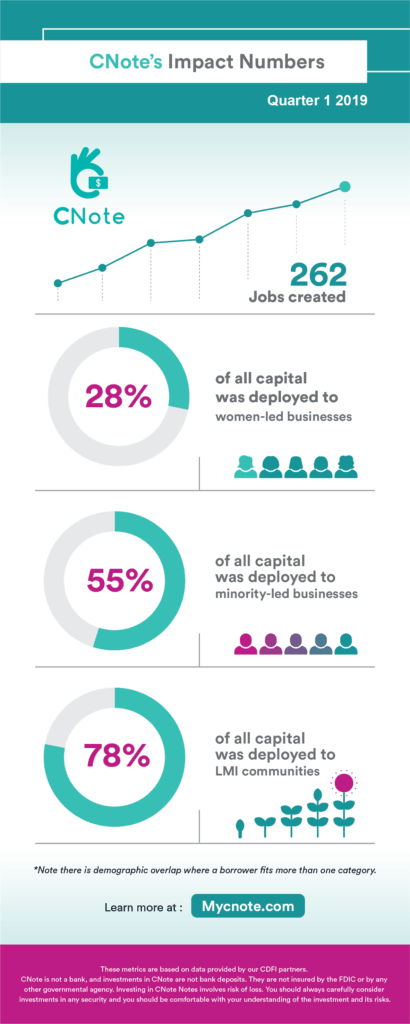
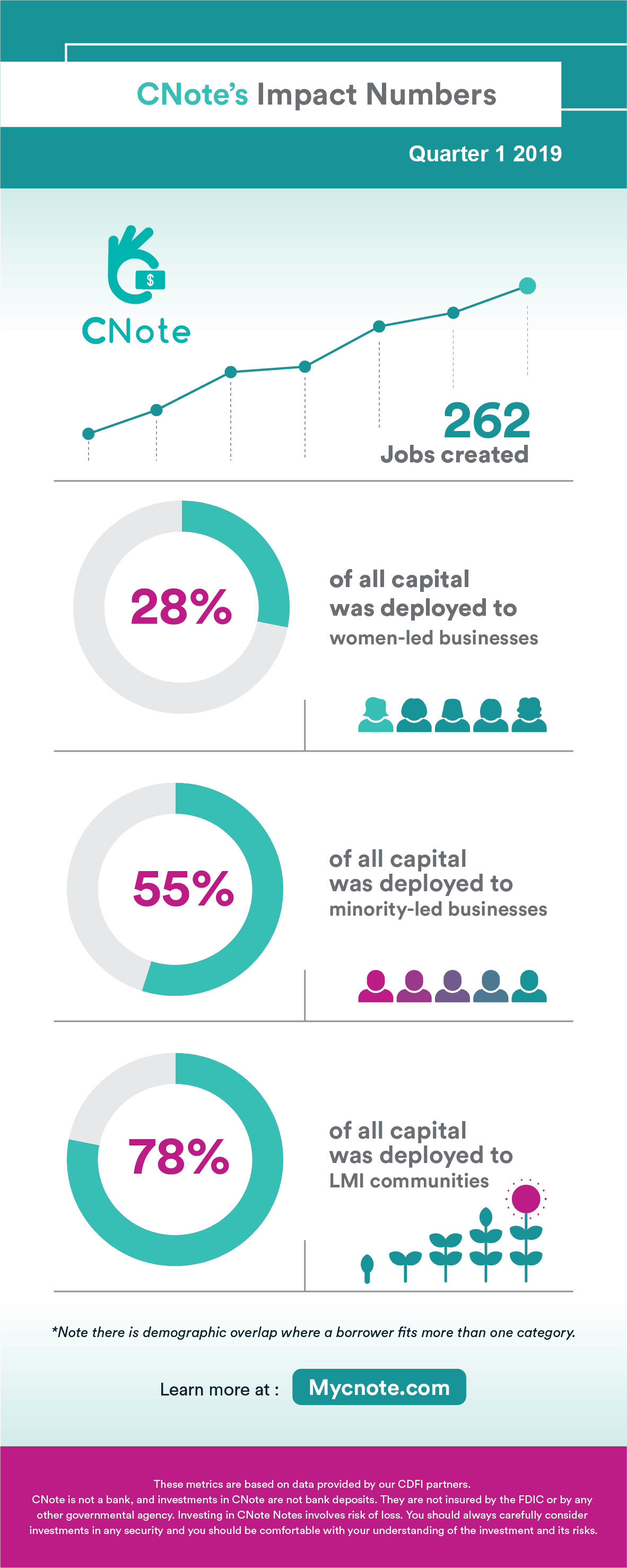
CNote’s Q1 2019 Impact Metrics – Infographic

We know one of the main reasons you invest with CNote, is because of the impact your investment has.

We’re proud to share our Q1 2019 impact data.

In Q1 2019, our members helped create/maintain 262 jobs!

Over half of all invested capital was deployed with minority-led businesses. We’re also extremely proud to announce that more than 78% of CNote capital went to LMI communities!

If you’d like to see our annual impact data, along with an explanation of how we map CNote’s impact investments to the UN’s Sustainable Development Goals, read our 2018 Impact Report.


By Change Makers Series, Migration V2

Change Makers Interview: Tory Dietel Hopps

You could say that philanthropy runs in Tory Dietel Hopps’ family. She’s a fourth-generation inheritor, philanthropist and activist, and she spent the first 25 years of her professional career in the nonprofit sector, focusing on resource development, management and governance for nonprofit organizations in education, health and human services.

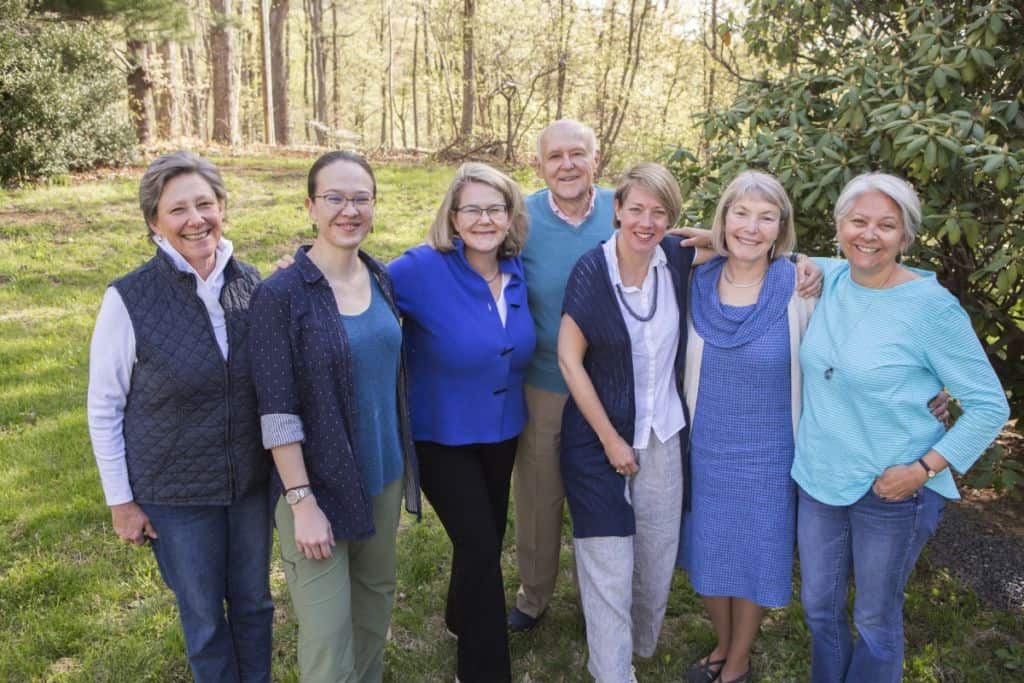
Dietel & Partners Team, Tory pictured 3rd from the left.

In 2007, Tory joined her father, Bill Dietel and oldest sister, Betsy Dietel to create Dietel & Partners. Today, the firm provides counsel to more than a half dozen clients whose assets range from $40 million to over half a billion dollars, and Dietel & Partners works closely with over 200 grantee organizations.

CNote sat down with Tory to talk about her career, the nonprofit sector, and donor-advised funds, and we got the chance to hear her thoughts on mission-driven giving, blended investment strategies, and the future of philanthropy.

CNote: How did Dietel & Partners come about?

Tory Dietel Hopps: Dietel & Partners was formed when we were asked by a multigenerational family to build a shared-family philanthropic office. It was an unusual arrangement; it was my family working with another family. Since then, we have specialized in working with multi-generational families and individual donors who have used donor-advised funds and/or foundations. And some have simply done their philanthropy out of their checkbooks. We are vehicle agnostic. The preponderance of our clients have operated without experienced philanthropic council prior to engaging our services.

CNote: What’s something special about your firm?

Tory Dietel Hopps: Our firm is an expression of our values as a family in terms of our commitment to social justice, a deep interest in women’s equality, and a keen dedication to the future health of the planet.

Because the three original partners and everyone that we’ve hired since have all had extensive experience in 501(C)3 organizations, we have a dedicated interest in reforming the power dynamics that exist in our sector regarding grantmaking, as well as social finance more broadly. Operating in a sincere partnership model is in our DNA and is something that requires daily commitment; we take it very seriously.

CNote: How has the industry evolved since you first began your career?

Tory Dietel Hopps: One thing I would cite is the increasing number of people we see who are considering spending down their wealth in their lifetime or within the next generation’s lifetime. That’s been a major trend. It may be special to our practice, but almost every single person we work with has a spend-down mentality. This is a remarkable trend and it does create a sense of urgency.

I would also underline the importance of the increase in use of donor-advised funds. In addition, there is growing interest in the use of an integrated capital or blended capital model and we have seen more client interest in mission-aligned investing.

CNote: You mentioned some “power dynamics” earlier. What isn’t functioning as well as it could in this sector?

Tory Dietel Hopps: When I refer to power dynamics, I am referring to the often unconscious behavior of funders putting their interests and needs first and not recognizing the stress and strain that many of their grantee partners function under on a regular basis. A lot of it is not necessarily something that people mean to perpetuate, but it can easily create difficulties in terms of us all getting farther along the roads we’re trying to move down, regardless of the issue. Challenging those behaviors and bringing a service headset to our relationships is something that’s near and dear to our hearts.

CNote: What have you learned about working with grantees?

Tory Dietel Hopps: We think about grantees truly as partners on the ground and not simply as recipients of philanthropic funding. One of the first things that we ask our grantee partners about is the state of their cash flow. I think too many of us in philanthropy forget that frontline organizations are often walking a very tight financial rope. Studying the cash flow position of an organization tells us a lot about bandwidth and flexibility. It’s an often overlooked early question.

Second, we try to look at all the ways in which we can remove hoops that grantee partners all too often get asked to jump through one more time. So, before we ask an organization to make an application, we are as sure as possible their proposal is likely to be approved by our client partner. Organizations spend an unnecessary amount of time filling out applications, answering questions, dealing with site visits etc.  When we enter the process, we wish to be as forthright as possible about the prospects of support and try to streamline our process.

When we take on a philanthropic client, essentially, we say to the client, “We see both you and your grantees as our partners in this work.” We believe this partnership model is extremely effective.

CNote: What are the issues you’re most passionate about, and what are some solutions you’ve invested in that address those issues?

Tory Dietel:

We are firm believers in the power of human talent. Leadership training, particularly for women is something our family has long supported.  As a firm, we have provided funding for women’s leadership programs run by the Omega Women’s Leadership Center (OWLC) in Rhinebeck, New York. Omega works with a very diverse group of female leaders in government, nonprofit, and business. The OWLC’s tag line is “Do Power Differently” and we really support that.

Climate change is also important to us as a family and as a firm. As all too many of our policy makers are currently unwilling to take on leadership, we have been exploring ways to create change that is not dependent on our federal or state governments. For example, we’ve been looking at using market forces for change, and I have been personally deeply engaged with something called Health Care Without Harm, which is a global entity that is helping to lead the healthcare industry towards sustainability in their operations and address climate change as anchor institutions.

CNote: You mentioned donor-advised funds earlier. What’s your take on them?

Tory Dietel Hopps: Donor-advised funds (DAFs) are by far the fastest growing vehicle within the philanthropic landscape. DAFs can democratize giving. It’s a simpler solution and it’s financially much cheaper than starting a foundation. In my opinion, we do need some regulation around the donor-advised funds for greater transparency.  That being said, they can be a powerful tool for people that are interested in philanthropic giving. It’s not an either/or situation and foundations and DAFs have different capabilities and benefits.

CNote: Is it more challenging to do grant making through the traditional foundation approach versus a donor-advised fund, or are the challenges relatively the same?

Tory Dietel Hopps: It can be important to have both arrows in your philanthropic quiver. The donor-advised fund approach now appears to be more open to impact investing. One of the ways that I got introduced to CNote was through a brand-new entity called CapShift that’s providing impact investing capability through donor-advised funds. So, I think that with the right investment advisor and strategy, you can use a donor-advised fund very creatively, just as you can with a foundation. Typically, the donor-advised funds are in essence democratic and funds can be started with as little as $1,000. Sometimes, the options on the investment side are not as robust with the smaller accounts, but it appears to us to be changing and I think that’s really good news for the sector as a whole.

CNote: To what extent do you see an integrated capital approach to grant making becoming more popular, and what components within that blended approach do you think have the most promise?

Tory Dietel Hopps: It’s a burgeoning area. We ought to be thinking about how we move everything towards mission and towards the reason why we have a charitable tax status. When I think about integrated capital, I think of a continuum, a horizontal line and at the far left I would put grant dollars and at the very far right I’d place equity. In between are a wide variety of different ways to utilize one’s capital to be helpful in achieving mission.  There is a lot of room for creativity.

Historically, the investment and grantmaking sides of most foundations and DAFs have been disconnected. The fundamental shift that needs to happen is to bring the investments more in line with mission. The options and opportunities are growing by the day.

My observation is that the once the intention is translated into adopting an integrated capital approach, the philanthropic process becomes much more effective because you’ve got additional tools and capital driving towards mission.

CNote: What advice would you have for someone who’s starting a foundation, launching a donor-advised fund, or inheriting wealth?

Tory Dietel: The very first thing that people should do is know what they own. So just being conscious of what’s actually in your holdings is the very first step. Okay, “I have an index fund.” Well, that’s great, but what’s actually in your index fund?  I just went through this recently with a client who has been doing remarkable and very cutting-edge grant making in the environmental field. On the investment side of the house, they had funds that were in index funds, and those index funds were holding companies in industries that the grant-making side of the house was working to shift and fight against, from a watchdog standpoint and from a policy standpoint. That doesn’t make a lot of sense. So, step one is really understanding what you own by way of investments before you start grantmaking. Your money is working all the time, and you need to ask is your money working for what you want it to be doing in the world both in terms of investments and grants?

CNote: What’s the future of philanthropy look like in the next five to 10 years, and what are you most excited about?

Tory Dietel: As philanthropy grows and younger people in particular become more engaged, donors are becoming more creative and experimental. We are moving away from foundations giving just 5% of their assets away in grants to foundations activating the other 95 percent for mission as well.  DAF holders are also beginning to work towards aligning of all assets towards mission. I find this shift to be very encouraging.

I’m not sure there’s a silver bullet or the perfect vehicle that’s right for everybody, but the fact that there’s experimentation going on is a good thing.  I think that the younger generations are more global in their exposure, their education and their interests. Technology helps us to connect in ways we never have before, which is exciting for the future of the field.

It is important that there is more focus on trying to hold the philanthropic community accountable in different ways. That is a positive trend if it continues with a desire to truly make things better and not simply to shame. That’s part of why I think some the regulation component is needed in the donor advised fund space and what could be really helpful – transparency is important, particularly within the donor-advised field.

Finally, I am fascinated by the current interest in building communities of practice. There are many associations, councils and networks of funder groups developing across all fields. For example, the number of members in the Sustainable Agriculture and Food Systems Funders has at least tripled in the last 10 to 15 years. That’s an exciting indication of the rise of these collective funding and learning entities. I see it as a positive sign that people do not want to work in silos but are eager to do things collectively and collaboratively to build more effective strategies. This has many positive implications for the future of philanthropy.

Special thanks to Tory Dietel Hopps for sharing her story and vision for philanthropy and impact investing.

About Dietel & Partners

The Dietel & Partners business grew out of the Dietel family’s collective experience in the giving and receiving sides of philanthropy. Our founder worked as president of the Rockefeller Brothers Fund for two generations. Today, three partners and a full-time team provide counsel to several clients and families. Together, they have almost 80 years of experience nurturing long-time relationships with some of America’s most influential families who have trusted their approach to philanthropy.  Dietel & Partners was certified as a Women Owned-Business in 2019.  www.DietelAndPartners.com

By Borrower Stories, Migration V2

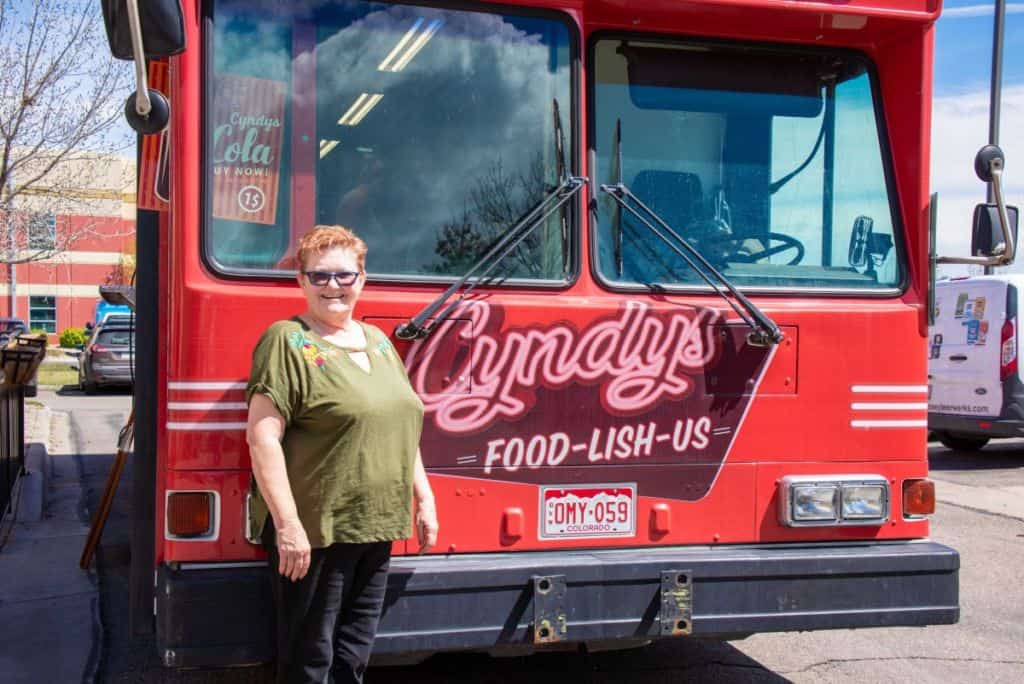
Food-Lish-Us – Cyndy & Dennis Scott and their family-run food…bus

Food-Lish-Us: A food…bus?

At any one of the community events around Denver, Colorado, there is bound to be a collection of food trucks. Nothing adds to the festivity quite like a dozen boxy vehicles, each emitting a steady stream of delicious food and mouthwatering aromas into the air. 

In any given congregation of food trucks, however, Cyndy’s truck stands out. And that’s because it’s not exactly a truck…

“My husband sent me out looking for a food truck. And I came back with a bus,” she recounted when we interviewed her about Food-Lish-Us, the business the couple started together. “My whole thing is I wanted to stand out…I wanted to be different…And so, you have to learn, ‘Okay, what’s the hook.’”


Indeed, her bus-turned-truck is twice as long as an ordinary food truck, cardinal red with a pink accented “Cyndy’s” displayed in large, looping letters. The background is painted to resemble an 80s cafe, complete with records and a checkerboard floor.

In terms of standing out and hooking customers, it does the trick. The unique bus is reflective of its owners, Cyndy and Dennis Scott, a couple united in pursuing their passions, helped along by a small business loan program for veterans like Dennis. 

“We wanted to do something for us. Something that we can control, versus somebody telling us we have to punch a clock.”

Their story is captivating, but what really draws a crowd is the food they create together.

Irresistible food that connects a community

Good food has a unique power to bring a crowd together. And the beauty of food trucks is that they congregate first, and the people come after.

“I get the biggest thrill out of watching people enjoy the food and loving it…”

Cyndy’s truck serves homestyle meals “just like Grandma’s,” meant to evoke a feeling of warmth and security. She dishes up burgers, fries, and most notably, Cubanos: a salute to Chef, the movie from which Cyndy and her husband originally got the idea for a food truck.

Indeed, her customers eat it up. Cyndy remembers with particular fondness the Parker Days, an event she served at which had over 300,000 attendees.

“We never had not-a-line in front of us,” Cyndy told us proudly. Throughout the 3-day event, she regularly left the truck to restock on ingredients, navigating through the crowds in a golf cart to reach her car and drive to the nearest grocery. Their truck spontaneously ended up being part of a parade at the end; and afterwards, people wanted to tour the inside.

Of course, there were stressful days, too.

At Brighton’s Tiny House Festival, she and her husband Dennis found themselves frantically trying to put out a grease fire that had combusted on the stove. Remarkably, their customers stayed in line; and once the fire was out, they proceeded to order food as if nothing had happened.

Either way, it seems that customers love Cyndy’s food. And that, for her, is the greatest reward. 

“I get the biggest thrill out of watching people enjoy the food and loving it. It brings comfort to me…and it brings comfort to them,” she told us earnestly.

Customers waiting to order from Cyndy

A lifetime of cooking and adventure

Self-described as a jack of all trades, Cyndy has enjoyed a diverse professional background. At age 15 she began her first job as a cook on a guest ranch in Wyoming. After that, she would become a nurse for 25 years, then a bus driver, a beautician, a tour guide, and a saleswoman in the auto industry. 

“My life has been one adventure after another. And this is the next chapter of my book.” — Cyndy, states on her website

Eventually, however, she and her husband Dennis decided they wanted to stop working for corporations and start doing what they loved.

“Our kids thought we were out of our ever-loved minds,” Cyndy laughed. “But we wanted to do something for us. Something that we can control, versus somebody telling us we have to punch a clock.”

Dennis Scott, a veteran who also had experience cooking in the military

She and Dennis began to look into the idea of starting a restaurant. The couple was disappointed to find that a brick-and-mortar restaurant was beyond their means. New inspiration came, however, when they watched Chef, a movie about a talented chef who quits his job in a restaurant to start a food truck, where he can enjoy the freedom of cooking his own recipes — a story not unlike their own.

So when they sold their house, they used the proceeds to buy the bus, taking the opportunity to make their dream into a reality.

Inching along

Cyndy and Dennis looking over a menu sign

Running a food truck is never a cake walk, and it was especially difficult in the beginning.  In their first year with the truck, 2017, Cyndy and Dennis relied on the volunteer efforts of their family and friends to staff their business — something which Cyndy greatly appreciated, but laughingly recommended not to do.

“Everyone that knows us, they can’t believe that we have yet to give up…”

To meet various expenses, the couple applied for a loan with a regional bank but were turned away. However, their banker referred them to the Valor program, an extension of Colorado Enterprise Fund (a CDFI that CNote partners with) which offers loans to veterans.

Dennis, who had served in the military and even cooked for the officers, qualified for the loan. After a simple application process, they received an approval within the week.

Cyndy looks on from the window of her truck

The loan provided just the financial cushion they needed to meet maintenance fees, buy inventory, and pay for unexpected expenses — like towing bills of up to $1,400 a pop for that oversized bus. In addition to the money, they also received invaluable financial consulting, such as training in Quickbooks. Cyndy recognizes the difference the loan has made in the smooth running of her business, and she is grateful. 

“Thanks to the Valor program, we’ve been able to inch our way along without too much of a headache.”

The adventure continues

Today, in addition to Cyndy and Dennis, Food-Lish-Us employs two professional chefs and two general hands. The goal is that Cyndy will spend less time on the truck, focusing instead on background work such as marketing.

Cyndy Scott and her husband Dennis (left) with their team (right) standing proudly outside their food truck

As for more long term goals, Cyndy and Dennis are thinking about adding another truck to meet the demand of their food at local events. And they have not quite let go of their dream to start a brick-and-mortar restaurant.

The adventure of the food bus continues — and who knows where it will stop next.

For now, the two are just happy to be along for the ride, doing what they love, on their own terms and bringing a smile to the world one Cubano at a time.

Learn More:

The Colorado Enterprise Fund, was founded in 1976 and is a non-profit lending institution that offers loans to entrepreneurs and small businesses unable to get traditional bank financing. For over 40 years, Colorado Enterprise Fund has been helping people realize their dreams of starting and growing their own businesses.

Food-Lish-Us – Visit their website to find out where they’re going to be serving up food next.

CNote – Interested in helping create another success story? CNote makes it easy to invest in great CDFIs like the CEF The Colorado Enterprise Fund, helping you earn more while having a positive impact on businesses and communities across America.