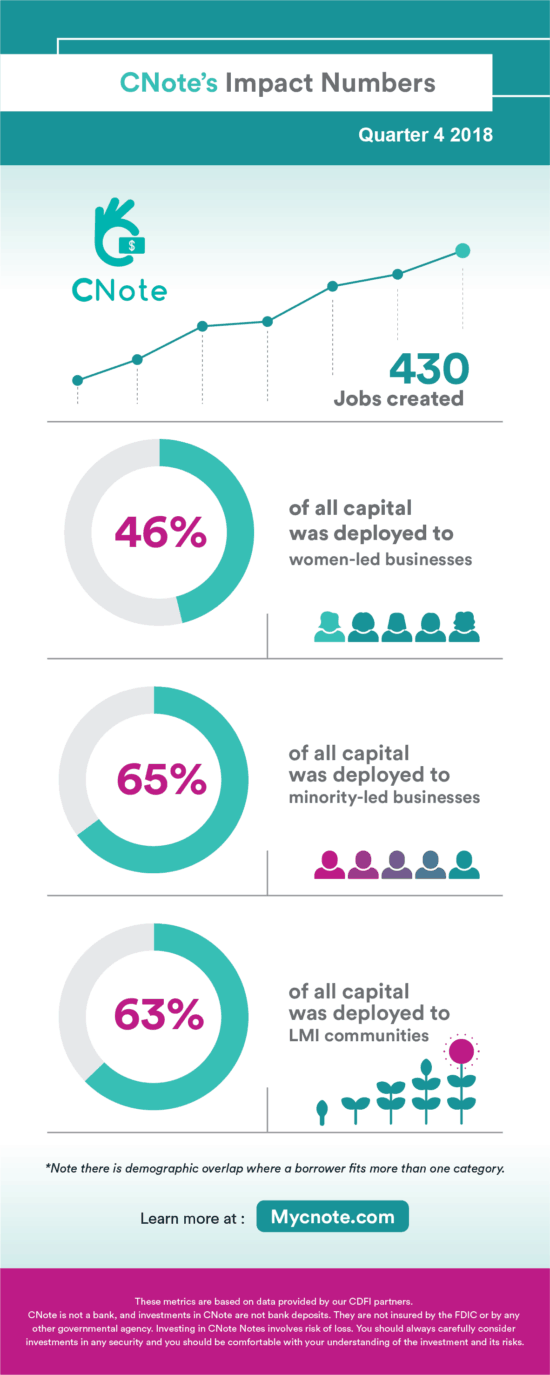
As you may have noticed, our quarterly job creation numbers are trending upwards along with our allocations across key demographics, like women, minority communities, and LMI communities.
In Q4 2018, our members helped create/maintain 430 jobs!
Over 65% of all invested capital was deployed with minority-led businesses!
We are extremely proud of our Q4 results and will be releasing our full 2018 Impact Report shortly. In the interim, check out our 2017 Annual report.
That idea is embedded in our social mission of closing the wealth gap and building a more inclusive economy for everyone.
Our team thought it was only natural we formalize that commitment by becoming a Certified B Corporation®. Now CNote’s commitment to profit with purpose becomes even more clear for our investors, members, and partners.
We’re excited to join a growing list of companies that are working to build sustainable businesses along with a better world.
B Corps were 65 percent more likely to survive the great recession in 2009
What B Corp Status Means
CNote was certified by the non-profit B Lab to meet rigorous standards of social and environmental performance, accountability, and transparency. That required us to evaluate how our practices impact our employees, our community, the environment, and our customers.
“Think of it this way: USDA certifies organic foods, and Good Housekeeping puts its seal of approval on quality products, like washing machines and skillets. And since 2006, a nonprofit organization called B Lab has been certifying corporations it deems to be concerned about their communities and the environment.” – NPR
Certified B Corporations® are a new kind of business that balances purpose and profit.
They are legally required to consider the impact of their decisions on their workers, customers, suppliers, community, and the environment.
This is a community of leaders, driving a global movement of people using business as a force for good.
The entire CNote teams is excited to be a part of this movement!
Join us on Wednesday, Feb. 27, 2019, featuring leaders in income and impact — Cat Berman, CEO of CNote; R. Paul Herman, CEO of HIP Investor; and Sonya Dreizler, CEO of Solutions with Sonya.
The webinar will be emceed by Sonya Dreizler, who helps advisors and financial experts pursue impact Investing, and how to better manage your RIA, Mutual Fund, and Broker-Dealer.
Please join us for an insightful exploration and deep discussion on Income + Impact, along with active Q and A along the way.
What We’ll Cover
This and much more:
Portfolio options that generate Income and Impact across multiple asset classes, including strategies involving muni bonds, real estate, cash alternatives, and other asset classes
How you can invest in community development and increase capital access for women and people of color
How to structure a portfolio to target UN Sustainable Development Goals (UN SDGs) across both U.S. and Global markets
When
Feb 27, 2019, at 1:00 PM in Pacific Time (US and Canada)
A tie can say a lot about its wearer. The first ties marked out the court members of Louis XIII, a French king who had admired the neck accessories of the Croatian mercenaries and adapted them as mandatory attire for royal gatherings.1
In the following 300 years, ties evolved into the more simple and streamlined form we know of today, but through subtleties in color and pattern they continue to provide distinction to their wearer. A red tie, for instance, can signal charisma or authority, while a tie covered with hotdogs might send a different message altogether.
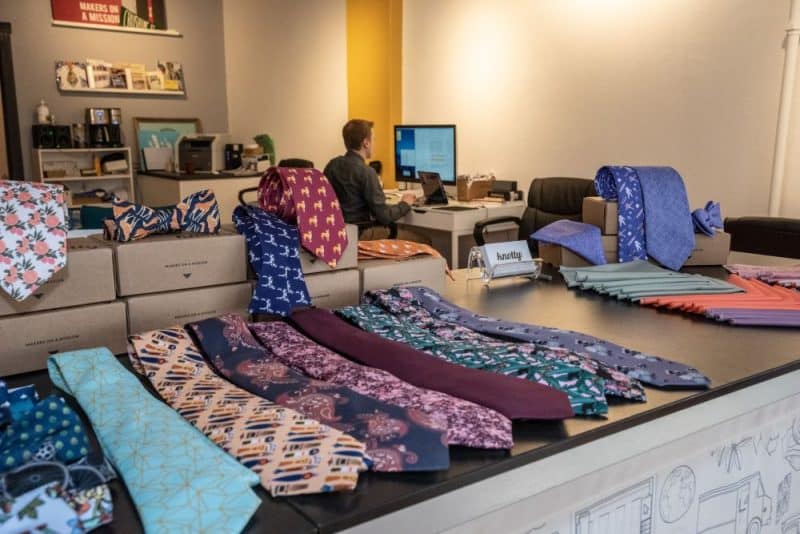
Product offerings at Knotty Tie Co. in Denver, CO
That said, a tie is an accessory you want to get just right. Knotty Tie Co. makes it easy to do just that.
From its chic and accessible e-commerce site, customers can select and order ties from the comfort of their own homes. With over 350 patterns and 560 color options, they can design just the right tie, bowtie, or scarf for any occasion: from themed wedding attire to workplace swag, to a thoughtful gift for a loved one. They can even customize from scratch, entering their ideas on the website, which the company’s graphic designers will then mock up for them.
It’s a unique company that creates unique ties. But even more distinctive is the story behind it.
A unique business model derived from an altruistic mission
When we asked what he did to make his customers happy, President and CEO Jeremy Priest mentioned the phrase Made in America.
“For us, Made in America isn’t just a reason to buy…”
What this means is that his company produces every tie in their facilities in Denver, Colorado. With equipment they bought and painstakingly learned how to operate, they print the patterns customers select onto quality fabric. Then they sew the fabric into ties — completely by hand.
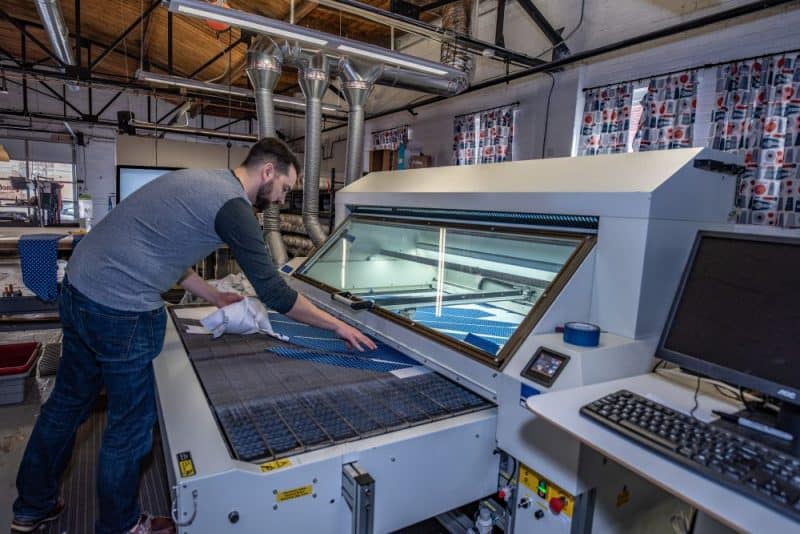
Employee operating textile cutting machine at Knotty Tie
This allows them to produce small batches of customized ties in a relatively short amount of time, something their competitors, many of whom manufacture overseas, cannot deliver on.
“For us, Made in America isn’t just a reason to buy, it legitimately gives us a competitive advantage,” said Jeremy. Later he added, “It’s incredible how the mission [of the company] weaves into that.”
And it’s the mission of Knotty Tie Co. that truly makes it stand out. Surprisingly, it has less to do with customized ties, and more to do with the people who make them. The employees who sew the final product by hand are all refugees who fled various conflict countries to start a new life in the US.
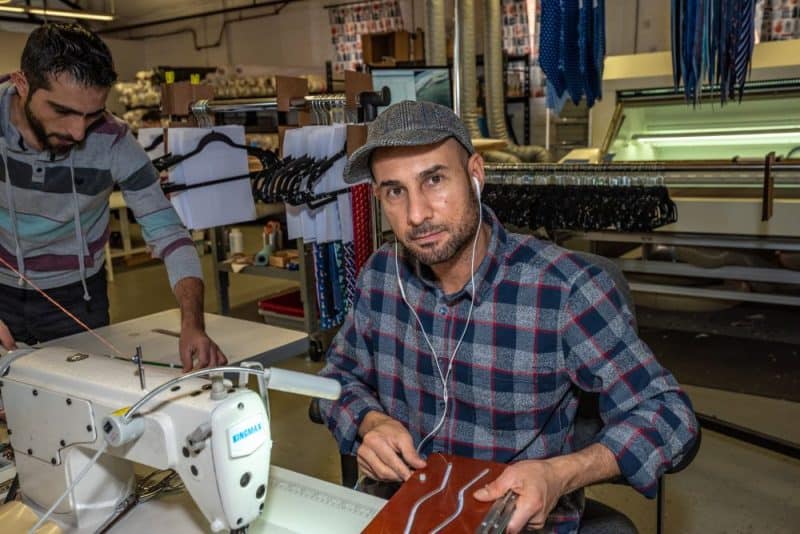
Refugee employees at Knotty Tie
And CEO Jeremy Priest’s mission is to provide them, and other refugees, with meaningful employment opportunities.
The birth of a mission
“The mission of the company is to create meaningful employment opportunities for refugees…”
Like most people, Jeremy didn’t initially enter adult life with enough belief in a cause to build an entire company around it. Instead, his convictions grew gradually through life experiences.
The first of these was a military career of six years, four of which were overseas. “One of the things I witnessed in my military duties…was that people were yearning for economic inclusion and economic opportunities.”
Inside the store of Knotty Tie Co.
This inspired him to study economics and get an MBA in entrepreneurship. At the same time he was pursuing his studies, he saw that there was a population with economic need in his very own community: the 2,000 refugees who set roots down in Colorado each year.
“I really recognized that there were enormous barriers to employment and that society generically wasn’t really recognizing the barriers, and wasn’t recognizing the dignity of the arriving population and the contributions they could make,” Jeremy said.
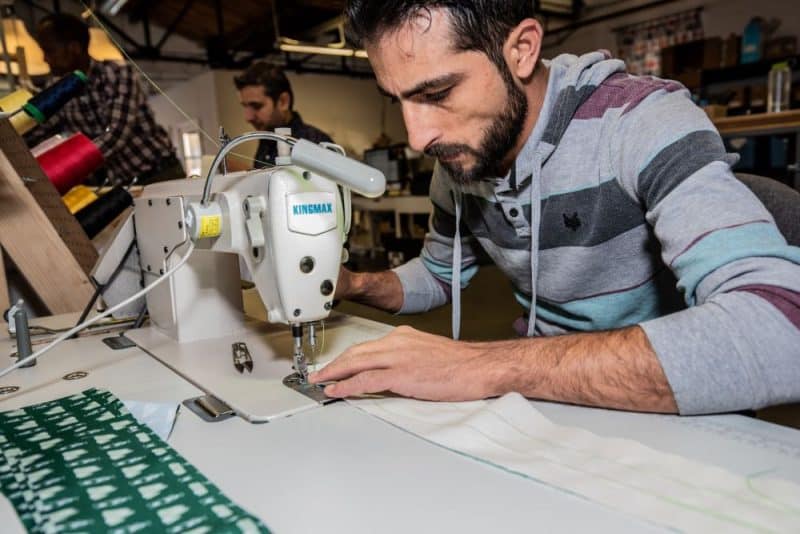
One of Knotty Tie’s employees intent upon his work
Instead, many refugees had to take random jobs with odd hours as they struggled to transition to their new lives.
Thankfully, there were non-profit programs that helped refugees transition, providing English classes and developing their job skills. Jeremy volunteered for one of those programs. But a key interaction in 2011 convinced him his clients needed something more.
“To me it seemed like there was just something missing…”
He was training two refugees in janitorial skills when they told him they had 20 years’ experience in sewing and a lifetime of experience in farming. In “a crisis of his conscience,” he realized he was training them in the wrong skills.
“I appreciated the resettlement agencies…But to me it seemed like there was just something missing — and that was the connection between [the refugees’] existing skills and the employment pathways we should be putting them in touch with.” And that made it less meaningful for them.
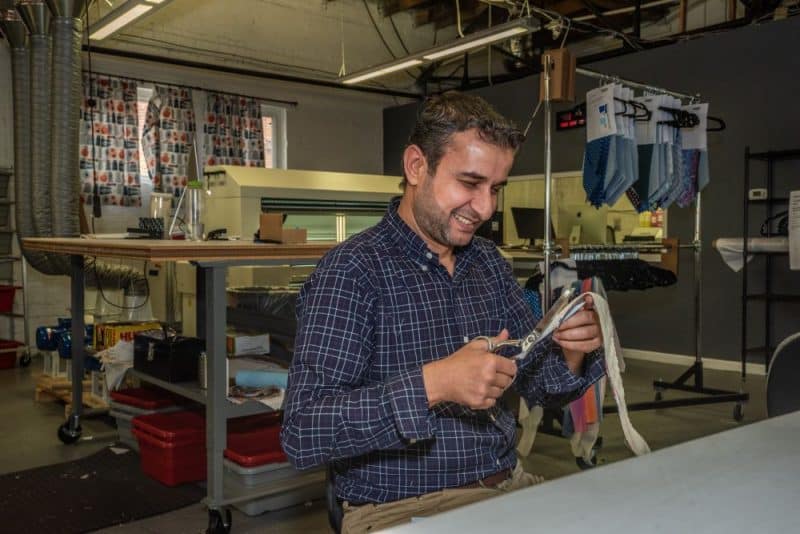
Employee cutting tie
Thus began an effort to convince the non-profit to not only train the refugees in basics, but employ them in their existing skills, namely sewing. But when Jeremy realized this was outside the scope of the program, he began to take matters into his own hands.
Scrapping it
Raising up his own enterprise to employ refugees in meaningful work was no easy task. In the beginning, it was just Jeremy and his undergrad classmate and co-founder Mark — and they had to scrap it.
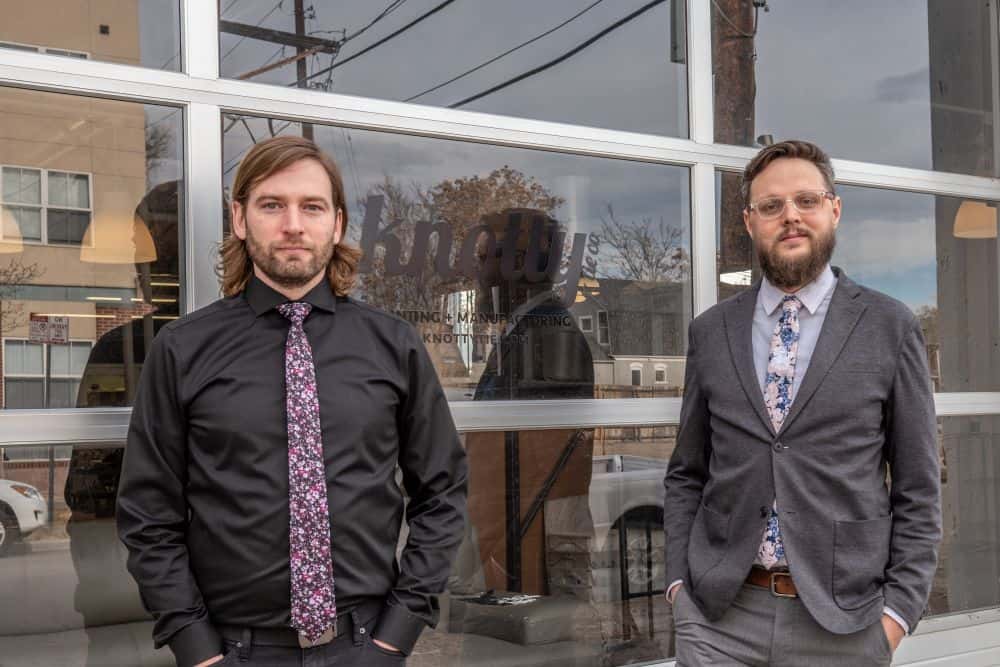
Knotty Tie co-founders Mark Johnson and Jeremy Priest
“Truth be told Mark and I were just so broke that we didn’t have cars,” Jeremy told us when talking about the early days of his company.
“Our first office was in an artist collective and we had to be able to walk there.” During their Kickstarter campaign in 2013, the two frantically produced ties, Mark in the afternoon after his shift at a cafe, and Jeremy all day before his night classes.
As the company took shape, they sought investors who would fund them despite them not having a high credit score. Thankfully an impact investor gave them seed funding of $40,000, and with it the valuable affirmation that their idea was worth all those long hours. This enabled them to hire two refugees with sewing experience and purchase some equipment to scale their efforts. It also qualified them to receive a loan of $10,000 from Colorado Enterprise Fund, a CDFI in CNote’s network.
“CEF was really an angel at the time in which nobody one else was willing to consider us on paper…”
With the money, Jeremy and Mark were able to meet payroll and purchase more equipment.
Later, when Jeremy showed CEF they could cut costs by two-thirds by manufacturing in-house, they provided a second loan of $100,000 to buy their own textile machinery. It was through CEF that Knotty Tie was able to fully implement its Made in America business model.
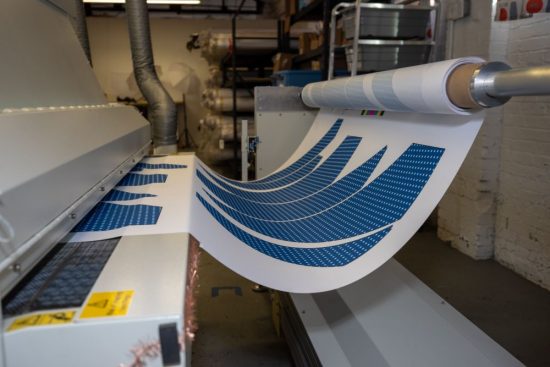
Knotty Tie’s textile printing machine
“CEF was really an angel at the time in which nobody one else was willing to consider us on paper,” Jeremy reflected. “They were willing to altruistically evaluate why we’re doing what we’re doing and what we were able to accomplish to date.”
Meanwhile, Mark, who was talented in technology, had taught himself graphic design and e-commerce and taken classes in full-stack web development, all of which equipped him to make the beautiful storefront website we see today.
Future plans for Knotty Tie
Mark and Jeremy in front of their storefront
With his signature eloquence, Jeremy told us of his future plans. His vision–both lofty and inspiring–includes developing business models to employ refugees even in camps overseas.
“These are refugees, but they are self-sufficient.”
In general, he wants to spread his mission of refugee employment to other for-profit enterprises, changing the global narrative from refugees who are helpless, to “These are refugees, but they are self-sufficient.”
But for now, he is focusing on the tie company, which he hopes to make a shining example of refugee resettlement enterprises to the world.
Marc Munyakabuga, production manager
We think he’s doing a good job of it. To date, Knotty Tie has a formal board of manufacturers consisting of seven members. Additionally, it employs six sewing refugees, two of whom have started college courses to pursue careers in fashion design.
One Congolese refugee named Marc currently serves on the board as production manager. In the future, he wants to start his own small business.
Learn More:
The Colorado Enterprise Fund, was founded in 1976 and is a non-profit lending institution that offers loans to entrepreneurs and small businesses unable to get traditional bank financing. For over 40 years, Colorado Enterprise Fund has been helping people realize their dreams of starting and growing their own businesses.
CNote – Interested in helping create another success story? CNote makes it easy to invest in great CDFIs like the CEF The Colorado Enterprise Fund, helping you earn more while having a positive impact on businesses and communities across America.
Our mission at CNote is to create competitive financial products that make money for our investors while building a more inclusive economy.
Seriously.
We know its a big goal, but big goals can create big change.
Some Exciting News
Occasionally, we’re lucky enough to receive industry recognition or build partnerships that help push us towards our goals and remind us that the work we’re doing resonates with a broader audience.
This week is one of those weeks for our team.
We wanted to briefly mention a few highlights we’re proud of.
It’s a long-running program with a track record of helping startups build key partnerships and gain broader access to customers, investors, and ecosystems.
Nearly 200 companies have participated in the program, and we’ve connected with nearly 10,000 of the world’s smartest startup founders to build the future of commerce together.
Thanks to the entire Mastercard team for their support!
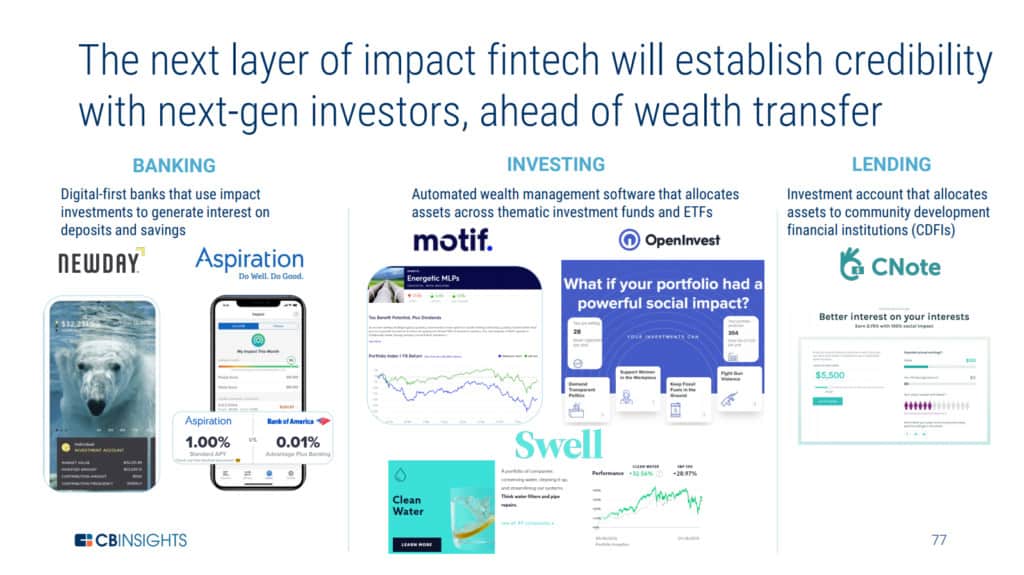
We were previously invited to their Demo Day event, and given CB Insights’ growing reputation as a key provider of business intelligence and predictor of trends, we’re grateful they think our impact-focused Fintech company is worth a mention.
If you’re interested in Fintech or just enjoy lots of charts, their 2019 report is worth a look. The slide (p. 77) mentioning CNote is excerpted below.
Credit: cbinsights.com
We’re hoping 2019 is filled with even more milestones like this. Learn more about CNote.
This site uses cookies. We use cookies to improve and analyze your experience on our website and for marketing purposes. Because we respect your right to privacy, you can choose not to allow some types of cookies below. Blocking some types of cookies may negatively impact your experience on the site.
This website uses cookies. We use cookies to improve and analyze your experience on our website and for marketing purposes. Because we respect your right to privacy, you can choose not to allow some types of cookies below. Blocking some types of cookies may negatively impact your experience on the website.
Necessary cookies help make a website usable by enabling basic functions like page navigation and access to secure areas of the website. The website cannot function properly without these cookies.
Marketing cookies are used to track visitors across websites. The intention is to display ads that are relevant and engaging for the individual user and thereby more valuable for publishers and third party advertisers.
Preference cookies enable a website to remember information that changes the way the website behaves or looks, like your preferred language or the region that you are in.